Creating this podcast has led me to meet all kinds of wonderful people (literally countless) and, well, here’s another one! I loved having this chat with Vincie; it was one of those chats that could have gone on for hours if it wasn’t for the time difference making that too close to midnight my time.
Show notes: Episode 255 of The Thoughtful Travel Podcast
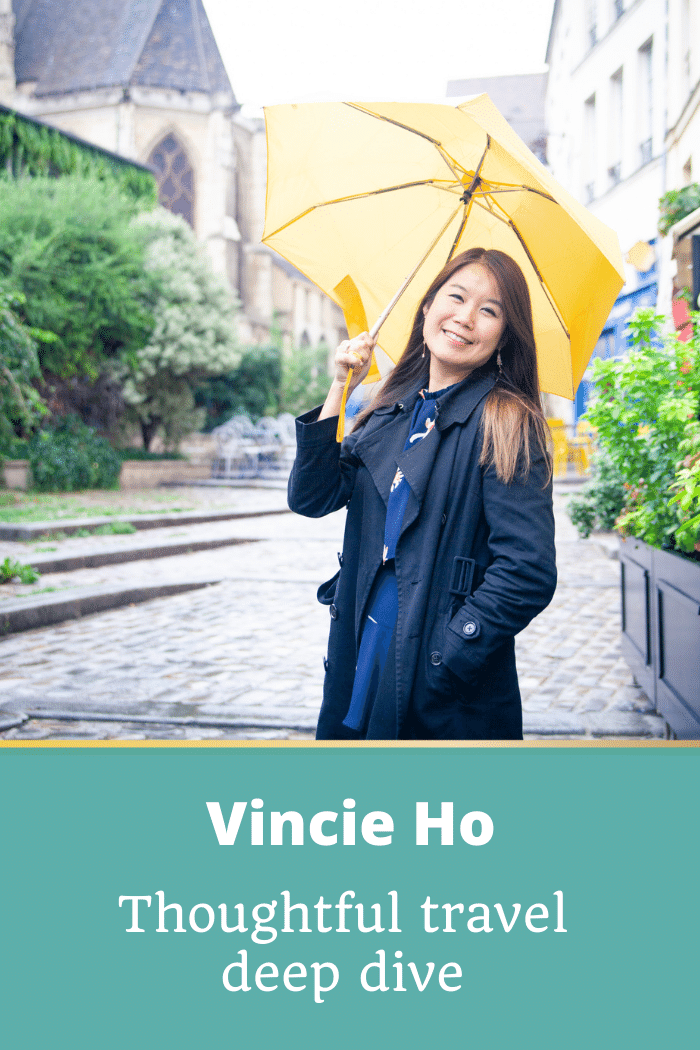
Vincie Ho: Deep Dive Into Thoughtful Travel
In the fourth of my Deep Dive Into Thoughtful Travel interview episodes, I chat with Dr Vincie Ho, founder and executive director of the RISE Travel Institute. We met while I was studying for a Certificate in Sustainability and Anti-Oppression in Travel through RISE and I couldn’t wait to chat with her about her travel history.
Vincie and I discuss where her love of travel came from, some of her experiences in studying abroad and volunteering, and what her hopes are for RISE Travel Institute and the future of thoughtful travel. It’s a great chat which I can safely say we both thoroughly enjoyed, and hope you do too.
Links:
- My capstone project from my recent RISE course – my topic was ethical wildlife tourism – Episode 252
Transcription
Amanda Kendle 0:00
This is the Thoughtful Travel podcast. I’m your host Amanda Kendle of the not a ballerina.com travel blog. Every episode I’ll share travel tales from several fellow travel lovers. And together we hope to entertain and inspire you remind you of some of your own great travel experiences and encourage you to hit the road again soon.
Hello, and welcome to episode 255 of the Thoughtful Travel podcast. I’ve got a deep dive interview episode for you today. You will probably remember I’m doing these about once a month or so when I find people that I just want to talk to you for an entire episode because I know they’re going to have amazing things to say. And that is absolutely the case with this one where I’ve interviewed Vincie Ho who has a deep dive into thoughtful travel. So regular listeners or if you’re in my Facebook or LinkedIn groups, you will probably remember me talking about the course I’ve just taken with the RISE travel Institute. Actually, I presented my final project for that course as episode 252, so if you’ve listened to that you will definitely be familiar with my course. So today’s guest is actually the founder and executive director of the RISE travel Institute. I got to know Vincie through the monthly online meetups during the course, and I knew that I would love to have a proper deep dive chat with her. I mean, she developed an entire curriculum on thoughtful travel, so she is the perfect guest for this podcast. I wanted to start back at the beginning and find out how Vincie’s travel career started. So I asked her about her first trip abroad.
Vincie Ho 1:44
The very first time that I traveled abroad was when I was in third grade, my parents took me and my brother to Hokkaido, Japan. And it was during a brutal winter, it was minus 20 degrees Celsius.
Amanda Kendle 2:04
Why did they choose Hokkaido in the middle of winter? To go skiing?
Vincie Ho 2:08
So my parents, they didn’t have a lot, but they really wanted us to have very special travel experiences. So they said, Well, you guys have never seen snow. So would you like to go to Japan, and then we can play in the snow. And then we can learn how to ski. And, you know, they were really trying to be thoughtful for their children, wanting the snow experience for us. But then it was so cold that I got sick for the entire week. I was puking every meal. I’m not sure if this was supposed to be…
Amanda Kendle 2:52
This is real life, real life.
Vincie Ho 2:56
It was very real. I was nine years old. And I actually got to enjoy it. I mean, I didn’t feel sick, except for when I was at dinner time, my body just couldn’t digest the food that I took. But then I was playing happily with other kids on the tour. We joined a tour. Back in the day, that was the only option. People didn’t know, especially people from Hong Kong, back then. It was organized tours mostly. And backpacking wasn’t a thing, especially for families. So we were in a group and there were, I don’t know, like ten kids, so it was really fun. And the one thing that I really regretted, was because I was so sick and that it was really cold and I had to stay in the hotel, and my parents had to stay with me to take care of me and they missed the Sapporo Snow Festival. That was supposed to be the most beautiful ice carving festival in Asia. So they missed that. And it’s still one of my dreams to take them back to Sapporo. We did go back as a family but it was in summer. But I still really hope that one day I can take them back to Sapporo in winter time to go back to the Sapporo Snow Festival.
Amanda Kendle 4:36
I’ve seen pictures of it. It’s amazing, isn’t it? I know it is.
Vincie Ho 4:39
So that was my very first travel experience outside of Hong Kong. And the first time that I traveled abroad alone, without my parents was when I was studying in France. So I was staying with my host family in Brittany – who I’m still very much in touch with – and they basically adopted me as their third daughter. I still saw them every year until the pandemic hit. So around that time, I decided to go backpacking by myself with a couple of guidebooks and a giant DSL camera that I borrowed from a friend that I had absolutely no idea how to use. And then I just traveled around in France as a 19/20 year old Asian girl, I went to Provence, The West Coast, Normandy and one day I got stuck in Chamonix in the Alps, because the National Railway was on strike.
Amanda Kendle 5:53
Yeah, of course.
Vincie Ho 5:57
And then I just looked around, and I didn’t know what to do. I found a school bus and I just hopped on and talked to the driver. I said, I needed to leave this place. And he said, Yeah, come on in. I just hopped on a school bus full of kids, like school kids going back to Lyon from that excursion. And that was my first…
Amanda Kendle 6:21
That’s magical. Well, you’re a genius.
Vincie Ho 6:26
But that was the first time that I said to myself, wow, like people are really nice, right? Like, when you when you have the courage to interact with them, and just ask, people usually, generally would be willing to help, especially when you’re alone or in trouble. And two American girls, who I later met on the road, I told them about this, and they said, Wow, you’re very brave. And honestly, back in the day, like back then I had no idea why they said that. But now looking back, I’d say, yes maybe there’s a fine line between courage and recklessness, right. Yeah, but a school bus full of kids, Mmybe that was safe.
Amanda Kendle 7:16
Absolutely. Probably a lot safer than any other option at that moment. But it still takes courage to go into that situation and to speak to them. And it’s a foreign language. And you know, there’s all sorts… it’s a bit unusual. Like they’re not supposed to just pick up backpack random backpackers.
Vincie Ho 7:37
I was probably looking very helpless.
Amanda Kendle 7:43
Probably. That’s useful sometimes. Can I go back to that? What made you want to go to study in France?
Vincie Ho 7:49
That goes back to when I was 12 when I graduated from primary school, and we were with my mom. I think this is something that might sound funny to a lot of people who are not Chinese. But for ethnic Chinese, like having to learn Chinese language as a kid is actually really tough, I believe. Having to learn all the strokes and how to write 1000s of characters, right? So I struggled a lot. I actually did really well in school when I was young but I struggled with the Chinese language. So when I graduated from primary school, I told my mom, I don’t want to continue with Chinese, I want to learn French, because – well, French came up so randomly, because French was one of the most popular foreign languages, the third language that people learn in Hong Kong especially. There was a migration wave back then, before 1997, and people wanted to learn French to be able to emigrate to Canada because they would have more points. So I said, I don’t want to learn Chinese anymore. I want to learn French. And then my mom was like, well if you want to learn French, that’s fine, but you still need to learn Chinese because I want you to be able to read the newspaper and write in Chinese when you grow up. So I said, okay, then I gave in, and learned an extra language started at the age of 14. I started to pick up the language and so naturally, when I grew up and I went to college, I majored in French and then I decided to study in France.
Amanda Kendle 9:51
That’s awesome. Isn’t that funny? The path that life can take from pretty random decisions…
Vincie Ho 9:58
Totally. I still I remember vividly that conversation with my mom. And it’s magical because it changed my entire life. I became a French lecturer for one and a half decades afterwards and, now even sustainable travel, the one thing that I’m doing right now is thanks to this study abroad experience and all the travels that took place afterwards.
Amanda Kendle 10:32
Imagine if you hadn’t taken up French, what would you have done? Because you wouldn’t have gone abroad, and then all sorts of doors wouldn’t have opened and who knows what you would have done or where you could be now. So as you can hear Vincie is the kind of traveler who approaches travel in a really similar way to me, so that made me want to ask her, what she considers makes a trip successful.
Vincie Ho 10:57
It’s really hard to define success. I would say a successful trip to me is a trip that is sustainable and thoughtful; a trip that involves a minimum of carbon footprint on my part, and a trip that has some sort of social good components in it, whether it is supporting local women cooperatives or visiting an organization that that is involved in Sustainable Community Development, or maybe visiting a genuine animal sanctuary. S a trip that is successful to me involves chances to create deep connections with people like with the locals, and also travelers that you meet along the way. Like, for example, I love homestays. The kind of homestays I talk about, it’s not like a one-night thing, but at least for a few days, where you get enough time to get to know the local people and listen to their stories, and try their food and experience the way they live. That’s exactly how I became a member of my French host family, and I also got a host family in Thailand. You’re creating homes and building families around the world. So a successful trip for me is that it has to contain all these elements that I care about, with deep connection with the people, deep connection with animals in an ethical way. And also a deep connection with nature and the environment. Mass tourism is pretty much like a group of people rushing to different places within a short period of time taking pictures, and objectifying the culture, or the people at the places that they visit. So, this is something that I tried to avoid, I mean, I did that before. And now I try to avoid. I really enjoy going to one place and taking my time and let everything sink in and soak in. Yeah.
Amanda Kendle 13:24
So I really agree with Vincie’s ideas about how we can think about our travels to make them sustainable and thoughtful. And next, I wanted to get down to travel on a more personal level and I asked her how she has been changed by travel.
Vincie Ho 13:39
Travel has changed me completely. Before my study-abroad experience I was a rather ignorant young person completely uninterested in politics and history. I was doing really well in school and that was pretty much it. I was very focused on that one subject and just had zero knowledge about what’s going on in the world and being completely – I need to use the word again – ignorant, because that is was what I was. When I studied in France… you know, French people love talking about politics, right? And I liked so much hanging out with them, and that’s how I learned. That’s how I picked up my French. So I hung out with them all the time but then I realized that I couldn’t contribute to any topics of conversation because I just didn’t know anything back then. They were talking about contemporary politics or even a little bit back in the history… Second World War and the legacy. And I had my first Jewish friend and I had a Muslim friend and I had my first friend in class who was from Palestine and one day, we were making a class t-shirt with all the names and the countries we were from. And the organizer deliberately put Israel after her name. And she was in tears, and I did not understand what was happening, I had no clue. And all these incidents just drove me, kind of motivated me to get educated and to start reading about history around the world and what’s going on, and why are people reacting in such a way and why are people offended when we’re not using the right word? And why are Taiwanese insist on not being called Chinese? You know, back in the days, I was very insensitive about all these issues. But now I came to the realization that these are important things to them, and if I didn’t have this chance to study abroad and be exposed to so many people from different cultures, I wouldn’t have known, I would still be in my bubble, maybe graduating with a first honor and then go into finance or corporate, still not knowing what’s going on out there.
And not knowing that you didn’t know, which is the scary part.
Exactly. So that was my first experience where I felt vulnerable. Because for the first time I realized how much I didn’t know. And that really motivated me to start reading more and talking to different people more. And there was another time I asked so many stupid questions as well. Either I didn’t dare to ask questions and I would just sit there for the whole night not saying a word, or I would ask stupid questions that I still regret today. I remember I was doing my Masters in the UK and I told a friend from Singapore who was going to the same college and I was like, wow, you speak really good English…
And she was like ‘we speak English in Singapore!’ I didn’t even get why she was so offended Bbcause I was giving her a compliment. That was so stupid. That is so telling… that we all have so many unconscious biases about other people, other cultures and travel really forces you to come into contact with these other cultures and make you think about what assumptions you have about them, and who they actually really are.
Amanda Kendle 18:29
And you care as well because it affects someone you know; someone you’ve met, or a friend and like with the Palestinian girl in your class, then you care a lot more about what the story is. Because you can connect it to a real living person who you like or trust.
Vincie Ho 18:50
Absolutely. I have a friend of mine, I’m not going to mention his name to protect his identity. He’s a refugee from Togo. And we were friends, we hung out quite often in Hong Kong because I was volunteering with a refugee empowerment organization back then. And one day we met up for lunch and when I saw him, I was like ‘hey let’s go, I’m starving’. And then he looked at me with his eyes wide open, staring into my eyes and said, Is that what you call starving?
Amanda Kendle 19:32
I bet you’ve never said that again.
Vincie Ho 19:33
I never said that again, I promise. That moment was so powerful. Things that we take for granted and say so casually, can actually have layered meanings for other people who have experienced trauma and hunger or things that you cannot imagine living in a comfortable world. So to talk about privilege is one thing that we talk about a lot at the RISE Travel Institute. And it is so true when you travel, you realize how much privilege you [have] even though I’m an Asian, I am not at the extreme of the color spectrum, so to say. But when I was volunteering in Africa, I realized that even though I’m Asian, I was pretty much perpetuating white saviour reason[ing] So I took part in that, and even though I’m not white, I shared the privilege of people from developed countries, and benefited from the power difference of power dynamics. And the feelgood factor as well, believing that I was making a difference. I was doing something good, but actually having a very small positive impact, if any, and a lot of negative impacts on the people who I interact with.
What were you doing? What was what kind of work are you doing?
So I was in Rwanda, and I was in a children’s project, so basically, the one thing that we are told not to do now.
Amanda Kendle 21:25
Yes, exactly. We know a lot more now.
Vincie Ho 21:30
I didn’t know the negative impacts that I would have through what you call it: volunteerism or orphanage tourism, whatever you call it. Back then I didn’t know that wasn’t helpful, of course. But even when I was there, during the experience, I started to realize that something was wrong. Because every day, I was hanging out with the children, like walking around not really having anything substantial to do, or not having a task to help them build something or develop a curriculum, there was nothing like that. I was just hanging out in the orphanage, taking care of sick kids and taking them to the clinic. But then I wasn’t speaking the local language, so someone had to come with me anyway. So what was my place in that whole situation? How much help could I really offer and also with a few volunteers, we contributed to a pool of money to buy a whole bunch of chickens for the orphanage. We were thinking okay, maybe you teach them how to raise the chickens, so they can have eggs to eat, but then the next day, they just killed all the chicken for the meat. Because for so long, they didn’t have any meat to eat so that’s totally understandable. But the education part of it was missing. Right, the communication and the education and the purpose that wasn’t really clearly communicated.
Amanda Kendle 23:24
asking them what they need, rather than deciding…
Vincie Ho 23:29
Exactly! Asking them what they need, rather than us deciding what would be cool; so this was a whole learning experience. And also the connection that I built with the kids as well; when I was leaving they were in tears. And I can imagine every two, three weeks, they would meet new people having this hope that these people will take them home with them and every time it wasn’t happening. So it’s constant and it’s just so sad, little kids who was begging me to bring him home. But then they realize that these people are not here to stay. They promised… they would bring you hope and future but then after a few weeks they’re gone. I don’t know how much [of a] psychological toll that our visits would have had on the kids and people aren’t asking about these things when they go.
Amanda Kendle 24:37
No, exactly. It’s only a few years ago that I really learned that this is what goes om, the case in Cambodia where a lot of them aren’t even orphans and all, this kind of stuff. Lots of people still don’t know because you have to dig a bit deeper to find out all this stuff.
Vincie Ho 24:57
So just to wrap up, my answer to your question: travel did really change me a lot, and I think the transformational bit was there were so many learning moments and I just keep learning along the way. And all these mistakes that I’ve made paved the way to what I’m doing right now.
Amanda Kendle 25:30
Yes, the learning from these experiences is just so powerful. I think that Vinci’s story about the chickens is something I’ll probably repeat many times in the future, as it’s a simple but perfect example of how not to help the locals when we travel. We talk a lot on the podcast about not feeling bad about what we’ve done in the past, things that we now see as something that’s negative, but we know more about now. So, Vincie, I’m super appreciative of you for sharing these stories so honestly, it’s very useful to hear. Anyway, to finish off our chat. I asked Vincie to explain more about the RISE travel Institute and her hopes for its future.
Vincie Ho 26:09
I started RISE Travel Institute in June 2020, in the middle of the pandemic. People are like, why this is so counterintuitive? Organizations and companies are struggling to survive and you’re starting something, are you sure?
Amanda Kendle 26:28
Especially in the travel space, yeah.
Vincie Ho 26:33
But then I thought it was actually the best timing, because for once everybody’s not busy traveling all the time, for once people are grounded, and when you have time – it was in the middle of the pandemic, so a lot of people are picking up new hobbies, they have a lot of free time – and I was like: hmm, perhaps we can really take advantage of this unexpected moment to build something, to educate people, because I had always wanted to build a curriculum around sustainable travel, but I never really knew how, and it was never the right timing, because I was also busy traveling. So I never really found the time until the pandemic hit. And I was like, Okay, so maybe this is good timing. And also last June, if you remember in the US, there was this Black Lives Matter movement, and anti-racist movement nationally, and pretty much internationally as well. I just thought, anti-oppression is so important. Human rights and social justice have always been close to my heart. And I thought, maybe I should do something that talks about both – travel and oppression – because they are so interconnected. And people don’t always see it that way, because travel seems so harmless. But it is not, because while you’re having fun, you actually may be harming…
Amanda Kendle 28:19
Yes. You’re having an impact one way or the other. Positive or negative.
Vincie Ho 28:23
absolutely. So I was thinking, you know, maybe there’s a way to marry travel tourism and top profession and build a curriculum. So that was how RISE Travel Institute started. And then, very soon, people really loved our mission and vision and they started to approach us and then we slowly built this amazing team of volunteers. And today we have a remote team of over 40 people and they are super dedicated, very invested in the RISE Travel Institute as a baby, as their baby as well, not just my baby. And we started our pilot program this summer, and apparently, students love it.
Amanda Kendle 29:13
Yes. I am one I could say for sure. Yes.
Vincie Ho 29:17
So I’m really happy that they found it inspiring. And I also learned a lot from the interaction with the students and the instructors as well. So my hope for its future is that we can really mainstream sustainable travel education and like really reach,casual travelers so that before people travel they’ll come and take courses and educate themselves before they go on their trips, so that they can become more mindful travelers once you know they are visiting their destinations. So we will continue to grow, to build and expand our curriculum to include more courses on different themes related to sustainable travel, social justice, animal protection, environmental ethics, in relation to travel, and we are also hoping to be able to build these short courses on different travel destinations, to give travelers a deep dive into the history and culture of those places. And also how the legacy of history leads to the current social, economic, economic and environmental issues that are affecting the local population. And also maybe tips on how to travel more sustainably, like what all the credible sustainable development projects that travelers can get involved in when they travel to those places. So we want to be able to put together more and more resources for travelers and tourism professionals alike, so that when they travel, they have the tools and skills and knowledge to travel more mindfully and thoughtfully.
Amanda Kendle 31:18
Well, that’s it from my deep dive chat with Vincie Ho. And as you can probably hear, we both enjoyed it a lot. I just love meeting and getting to chat with such like-minded fellow travel lovers and hearing their story. So thank you so much Vincie. And thank you all listeners for listening in to Episode 255. As always, thank you so much for listening.
This has been another episode of the thoughtful travel podcast, show notes and other information are at not a ballerina.com/podcast Join me again soon for another chat about why we travel. Bye for now.
You might also like:
 The Thoughtful Travel Podcast: Episode 13 – Taking it Slow: Travelling to Feel Like a Local
 The Thoughtful Travel Podcast: Episode 20 – English Names, Widows and PNG in the 1950s
 The Thoughtful Travel Podcast: Episode 22 – Memorable Travel Moments: Hungry Porcupines and More
 How to be Bilingual – Episode 26 of The Thoughtful Travel Podcast
Leave a Reply