It’s been so heartwarming to have messages from listeners this week who enjoyed the first half of my interview with travel writer Paul Theroux so much that they couldn’t wait for the second part – when is it coming, I was asked quite a few times!
Well, it’s here now, and if you haven’t listened to Part 1 of this interview, I’d encourage it (although they probably stand alone to some extent, too). What I love about the second half of this interview was that I wasn’t nervous at all by this stage, and I got to ask some of the questions I really, really wanted to ask.
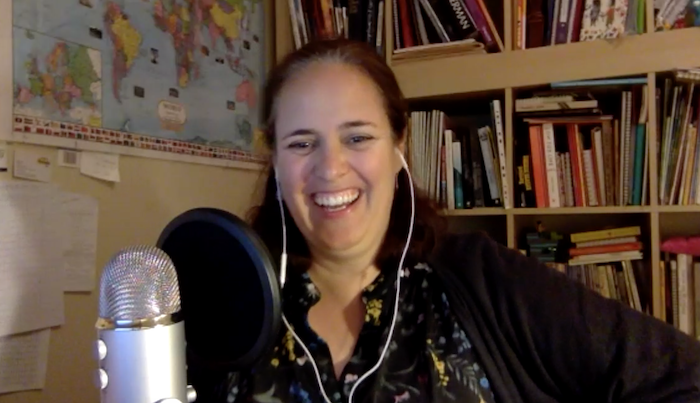
Paul also mentions my bookshelves – without saying they are messy, which is kind – and so the picture below shows you exactly what he was looking at! Enjoy the interview.
Show notes: Episode 215 of The Thoughtful Travel Podcast
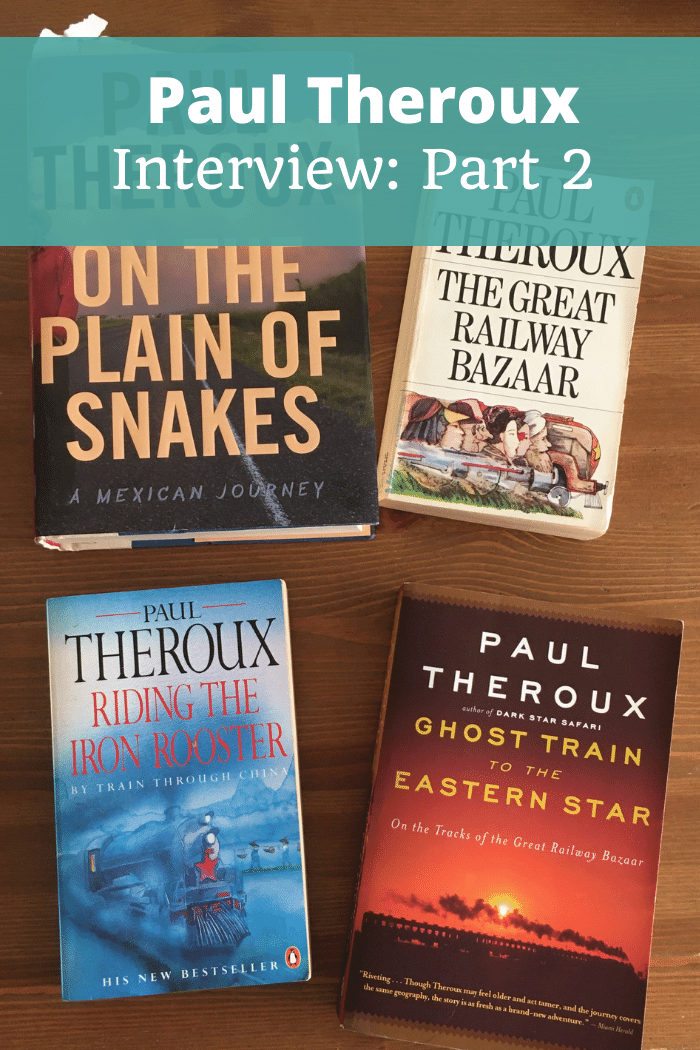
Paul Theroux Interview – Part 2
Paul Theroux returns! This episode is the second half of my interview with travel writer Paul Theroux – if you haven’t listened to Episode 214 yet, go and do that first!
In this final section, we talk about another widely-varied array of travel topics, including the magic of train travel, one of my very favourite ways to get around. We also chat about some cultural differences and discuss some of the things that are peculiar to Australians.
We move on to discussing road trips in Australia and the United States, and finish up talking about our children – I know that Paul’s sons Louis and Marcel have made truly impressive creative careers for themselves, so I ask him for some parenting tips!
I still feel so privileged to have had this great chat, and I hope you enjoy listening to it just a fraction as much as I enjoyed recording it.
Links:
- Deep South
- Riding the Iron Rooster
- Dark Star Safari
- Join our Facebook group for Thoughtful Travellers – https://www.facebook.com/groups/thoughtfultravellers
Transcript
Amanda Kendle 0:00
Hello, and welcome to episode 215 of the Thoughtful Travel Podcast. Today I have the second part of my interview with travel writer Paul Theroux. I won’t waste a lot of time fangirling the way I did at the beginning of last episode, because this half of the chat is even a little bit longer than the first half. So I guess not technically halves. There’s the mathematician in me being annoyed by that. But in any case, in this episode, in my chat with Paul Theroux, we talk about the magic of train travel. We talk about cultural differences. And Paul’s thoughts about Australians, which were wonderful. We chat about taking road trips in Australia and in the US. We talk about his famous sons Louis and Marcel, and I even asked him for some tips for raising my son well, so it’s a wide ranging conversation. I hope you find it as fascinating as I did. Now we pick up where we’re talking about ways to make better local connections and ways to meet people. You might remember last week, we talked about being a teacher in a foreign country, living abroad, even some unusual ways to meet locals – by for example, in the US going to gun shows. And my conversation with Paul picks up with some more suggestions on how to do this.
Paul Theroux 1:51
I wrote a book, as I said, called Deep South. It’s about traveling, a road trip around the South. I went to gun shows, you meet people, people at gun shows are friendly because if you’re there, it’s like a club. You’re a gun guy. You care about guns, you hate the government. You like the Second Amendment, and it’s like a Masonic Order. You’re on their side. I wasn’t really. I thought they didn’t know that. But I found also a very helpful way of traveling in the American South is going to church. So I went to a lot of church services. And when you go, usually there were black churches. So I would go to a small country town, and on a Sunday, show up at church, but introduce myself, I’d say, I’m Paul Theroux I’m from – I would say Boston, Massachusetts – I’m visiting, I’d like to join your service. They say Welcome Brother Paul, sign the visitor’s book. And then when you go into this church service, you’re introduced; so the pastor gets up and says, ‘We want to welcome our brother Paul, he is from Boston’. And then all the people in your general vicinity would hug you so you can hug, hug. And then you stand there, people testify, they talk about their lives. The preacher gives a sermon, there’s music, wonderful music, there’s faith, there’s belief, there’s hope. There’s also welfare, and because the church is the center of the community – these are poor communities – and so the church offers advice and food, money in some cases, counseling for education and family help. So it’s a centre, it’s the classic definition of a church, which is inclusiveness and help and hope. So at the end of the service, then people would come up and say, How long are you going to be here? Would you like to come over? And you know, we’ll be here next week. But what I did was I generally turned the tables and I would say, would you like to have lunch tomorrow? And they’d say, Yeah, fine. And or (to) the preacher, I would say, are you free? And I would take him out to eat, hear his story, or meat people. And often, you know, they were very interesting stories. I was traveling in 2012 on that trip, and there were people who had been in service, men who would show up in uniform. And I’d hear these stories about how they’ve been in the military in Afghanistan or Iraq. It was a very rewarding thing. But it meant that I had to make an effort. And I couldn’t just show up as a white person at a black church. They’re tolerant people, but they’ve had experiences with white people, they’ve been very negative, of course. So you need to be small, negotiate, get permission, explain who you are. And be a friend. I found that was very helpful. And it wasn’t only black churches, also white churches in Arkensas the white churches, but in Alabama and South Carolina and Mississippi that was better than a gun show as far as meeting people, and finding out what people’s lives are really like.
Amanda Kendle 5:26
Yes, exactly. Because it’s sometimes difficult, and I’m always trying to find new ways to do it. We were in Denmark last year and I got a little bit obsessed with the Danish education system, because it seems like in Scandinavia, the school systems are really amazing and really innovative. And we ended up staying in some Airbnb, which I carefully picked because the Airbnb host was a teacher, and we would be staying in their basement. So I thought we will have a chance to speak to them and this kind of thing. And so it’s a little bit contrived, because I kind of planned it, but I managed to find someone who was really happy to talk about the system, and I got to learn all this interesting stuff – to me, and my son would stand in the background, rolling his eyes, because he knew I’d be stuck talking for 20 minutes – but I loved it. And you know, there’s ways to have those conversations with locals. But you do have to think outside the box, I suppose like gun shows, and churches, I would never have thought of either of them. But they make perfect sense. So it’s very cool.
Paul Theroux 6:25
Any gathering of a group of people who are like-minded, the churches sector of the community in the South. It’s also why during the Civil Rights Movement, the segregationists blew up churches. that traditional churches get burned in the south, churches get bombed in the south, it still happens. In fact, I came across several instances of a church that had been burned. When you burn or bomb a church in the American South, you’ve destroyed or tried to destroy your community. And it can be devastating, except what generally happens is that people become more unified again, they band together. And usually there’s an effort to rebuild.
Amanda Kendle 7:05
So it has the opposite effect of the intended…
Paul Theroux 7:10
The opposite effect, generally speaking.
Amanda Kendle 7:11
I’ve just got a couple more topics I’d just like to touch on, I really want to ask you a little bit more about train travel. So you have traveled all of the most amazing train lines, you know, only a few of which I have had the privilege to travel on yet. What’s the magic of train travel?
Paul Theroux 7:26
For me, it was the effortlessness of it. When I lived in Central Africa, to get to the lake, because the roads were so bad, there was a train. The train went from Blantyre in Malawi, north up to the lake, and it took a whole day to get there. You left early in the morning, got there late at night. I worked in what they call the leprosarium. I was a teacher, but during the vacations I worked for this hospital. And to get there, it went into the bush. I loved taking the train, it was an old, rattly train, probably not running anymore, although there are trains; the Chinese have built or rebuilt trains in Africa. Then I lived in England, as I said, and I used to take the train, I often had an assignment in Scotland. So I take the night train, the sleeper to Inverness, or to Edinburgh, and I loved that. So when it came time to write a travel book, I thought, wouldn’t it be a wonderful thing – and a simple thing – to get on a train in Victoria Station in London, and go to Japan. The furthest you go, of course, is Afghanistan. Well, the border of Afghanistan, Misshet in Iran. But you get a train, change train, change train, change trains, you end up a couple of miles from the Afghan border. And then you go through Afghanistan, you get another train in Peshawar or the Khyber Pass, and you go down Peshawar, Lahore, Amritsar, go through India and up and down India. And it was the simplicity of it, the idea that you meet people. The train seems the embodiment of a culture: you get on a train in India, you have Indian food, Indian people, Indian manners, or whatever it is, and in different parts of India, different cultural attributes. So, it seems to be perfect. It’s not now – the old stopping rattling train is almost a thing of the past, except in a few countries – now speed is the thing.
But still a train is the embodiment of a culture; you know that for yourself, you’ve lived in Japan. The Japanese train is efficient, it’s fast, there’s Japanese food on it, and you might meet someone to talk to. I suppose, I mean, I don’t speak Japanese, I’m sure you do, or can get along with it still. It’s the quickest way of getting through Japan. You’d be insane to try to drive in Japan. German trains reflect the culture. I’m sure your country will still do. Train don’t exist in Mexico anymore, so I’m glad that I took them when I did, because I took trains from Laredo, Texas to Mexico City to Veracruz then down into Chiapas. And there were quite a few trains at that time, that was 1978. But you see why – you can ride on a train, you can sleep on a train, you can meet people on the train, you can get up and walk around, you can look out the window, you can get off the train, and spend a night there and then get the train the next day. So it seems to be ideal. American trains are few and far between. We still have them and I’ve taken them lots of times; it’s easier to get from where I am now to New York City or Washington by train, than driving. I just go to Providence, Rhode Island from here park my car, get in the train, I could be in New York in two and a half hours. If we’re driving,it would be about four or five hours. And very stressful.
Amanda Kendle 10:50
And nowhere near as…
Paul Theroux 10:54
So I wrote a book about China called Riding the Iron Rooster. I took every train in China and China – like India – depends for most of its transportation, on railway travel. So everything moves by train: goods go by train, people go by train. And I found that was very revealing, that you could talk to people easily on trains. And I decided, I’m just going to take every train. I left London, I went to Mongolia. I ended up in Beijing. I went to Shanghai, I went to Hong Kong, I went back to Beijing, I went west to Shinjang, Turfan, Urumqi, that I went to Gaomu in Shanghai province. And then I said famously, there’ll never be a train to Tibet. And now there is a train to Tibet. I’ve never taken it. But it seems to me, you know, it’s an engineering marvel that you can. So that was that trip. Riding the Iron Rooster, which was published in 1988 is just about train travel, what people eat, how they behave, how they sleep, you know, I was in a compartment one memorable night with two honeymooners. They were in one bunk and I was in the other one. I mean, it doesn’t get better than that from the from the voyeuristic point of view. So anyway, that you said, What is it about trains? It’s everything, except that these days, it’s not quite the same. Even if you took trains in China, the experience I had in the late 80s would be different now: the trains are the faster, they’re more efficient, they’re probably less funky. I mean, in that time, in the 80s people would have a jam jar with with tea leaves in it – and everyone should try, get out an empty jam jar, washed out when drinking – and funky food, but it was the 80s and by the 80s it hadn’t been modernized. It was on the cusp of being modernized. But it was still a bit of Maoist Old China and it wasn’t just the jam jar, it was also the food and the pushing and shoving and people sleeping on top of each other.
That actually was very helpful, the idea that it was still like a folk society traveling by train. No Chinese have money, they can buy, they have a thermos, they don’t all have jam jars. And I would say the efficiency of the train has probably taken a lot of the colloquial fun out of it, but it still is a relief and a pleasure to know that you can be in Lisbon, Austria, Lisbon, Portugal, get on a train and go to Hong Kong without leaving the ground. You go from Lisbon and you just keep going and going and going. I was in Lisbon a couple of years ago and I said we go down the street here and get on a train and you can end up in China or Hong Kong.
Amanda Kendle 14:05
As someone who lives on a large island it always sounds amazing to me to be able to do that. And it’s especially amazing when you’ve been born down here where we can’t even drive to another country.
Paul Theroux 14:20
You could get near Australia, you can’t get to Australia but you could get to Ho Chi Minh City, but from Lisbon, from London. And from there, you can’t really… there’s no train from Vietnam to Cambodia, but take a couple of buses and then get to Bangkok and then you can end up in Singapore. Yeah, that’s near Australia. You could get near Australia.
Amanda Kendle 14:47
That is near relatively speaking. You’re quite right. It’s quite near to Perth…
Paul Theroux 14:53
But to be an Australian is to understand the nature of a distance. And there is a book called The Tyranny of Distance, I think. And so you’re cut off but that has its advantages.
Amanda Kendle 15:10
In the times of pandemics, it’s been proven that being here in Australia has been particularly advantageous because we’re cut off. So that’s a bonus. And I think even pre pandemic, I think being from a really isolated, faraway place gives us a different perspective on the world. You know, generally speaking, over proportionately represented a lot of Australians really love to travel, and will take long trips and have that exploratory nature and I think that maybe is a function of growing up somewhere where the rest of the world seems so very foreign, because it’s so very far away. And so then we’re really even more drawn to it. It’s not just around the corner, I think.
Paul Theroux 15:51
I also think one characteristic I’ve noticed of Australians is that because they’re isolated, or at least, far away, and on this island, they’re more attuned to the ways of the world that they’re outward looking. And if there’s a colloquial expression, a current trend, something cultural happening in the world, Australians are the first to pick it up. They have a way of detecting cultural currents in the world, that other people are oblivious of, that people take for granted. Other people that they don’t notice. So if there’s, if there’s a slang word, or a film, or comedy, or a book, or something new, I find that – I don’t know whether you agree with this or not – but I find Australians seize upon it, they seize upon it. The trouble is – Australians, I don’t say you don’t respect each other – but an Australian generally thinks that he hasn’t, or she hasn’t quite achieved fame and fortune till they’ve gone to another [place], till they’ve been recognized by another country, by the States or Britain. Is that wrong?
Amanda Kendle 17:07
No, that’s probably fairly accurate, I think.
Paul Theroux 17:09
The only people who are like that, I mean, Mexicans don’t believe that they’ve had any success at all, unless they’re recognized either in Spain or the United States; that they have no reputation. To have a Mexican reputation is like being famous and big in Brazil. But if you’re big in Brazil, you’re just big in Brazil. But if you’re a Brazilian and you’re famous in Portugal and the States, then you’re… so I don’t know whether that’s true or not.
Amanda Kendle 17:33
I think that’s largely true of the Australian way of thinking too. And also, we have a relatively small population. So to do well in Australia is not very much.
Paul Theroux 17:42
To compare the big country with a small country, and I consider Australia a big country, the Netherlands, Holland is like that. So the Dutch, it’s rare to meet a Dutch person who doesn’t speak English. It’s impossible to learn Dutch because everyone will speak to you in English, the Dutch are like the Australians in that that are highly attuned to what’s happening in the world, because they feel small, they feel cut off. It’s small, I mean, how many Dutch speakers are there? So they translate books very quickly, they’re very, very aware of what’s happening in Europe, in the United States, in England, and they, they read books in English before they read them in Dutch and the books tend to be cheaper and more accessible. So Holland is like that. It’s actually a function of education. It’s not just a cultural thing. Actually, I’m talking about educated Australians, who are aware of the world and educated Dutch people too. And if you went to a little farm in Holland, that might not be the case. But there aren’t many little farms in Holland. Most of the people are metropolitan urban people. But the way a country looks at the world, whether they look at the world as something to understand, something to be curious about, is very much to your credit as an Australian. I don’t know whether you know which other countries are like that. I don’t think Japan is like that, although Japan always looks at cultural crosscurrents. But there aren’t many: countries tend to be inward looking. I think France is inward looking. I think Italy is inward looking. Spain, I really don’t know. The United States is inward looking: the average American doesn’t know where Perth is. Australia as well. Where’s that? Here? Well, what part of it? They really don’t have a clue about geography. So Americans, we’re not outward looking. We don’t even translate a lot of books into English. Mexican literature, I discovered, is vast. A Mexican library – vast – of books that are not translated into English. So Mexican writers are unknown. We don’t have that outward looking quality that Australia has, Holland has, maybe Scandinavia has it? You know, I’m not sure. You were in Denmark – I don’t know whether you found it there. I’ve been inDenmark and I’m not even sure of that.
Amanda Kendle 20:12
Yeah, I’m not sure. But I would say potentially. Can I ask you… when I speak to some Americans about this, like you describe the inward looking part, or perhaps the fact that they don’t travel outside the US particularly much, they will often say to me, ‘but we’ve got so much variety within the US’. So there’s so many different cultures, subcultures or different immigrants from different parts, and the country is big. So the landscape varies. Is that reason enough… well it’s not reason enough to not leave, but is it some justification that there is already a lot to experience within the United States?
Paul Theroux 20:48
Yes, I think that is true. I don’t think it’s an excuse, although a lot of Americans are very timid about travel. I mean, I’ve met Americans who say ‘I wouldn’t go to India’, even in fairly intelligent, fairly worldly travelers, saying I don’t want to go to India. I don’t want to get sick, no thank you. I’ve met lots of people, and I say ‘well, India is big, you could take a train, the food’s great. North is different from South, East is different from West.’ No, I’m not going to do it. I do not want to go there. And yet they would go to China or Japan or something. So there’s a prejudice against certain places. A lot of Americans don’t want to go to Mexico, although many, many retire there. I mean, it’s full of communities. But when I was driving there, people were saying, ‘don’t go don’t go man. They are going to mess you up, man. You know, they will take your car’. And actually the problem I had in Mexico was with the Mexican police, not with Mexican civilians. But this idea that you can travel in the states and be in mountains, you know, Rocky Mountain, big, high snow capped mountains, and it takes a couple of days from there to being in the desert, really hot, steaming desert, steamy swamps in Louisiana, the plains, the grasslands, in wilderness, actual wilderness where you can get lost and die. Well, you can die in the outback.
Amanda Kendle 22:11
I was gonna say we have that.
Paul Theroux 22:14
You could die, you can die in Australia. But actually the size of the states does allow an American to travel. I don’t think that in general, Americans like to go into places where they’re going to feel strange. For example, when I traveled in the south, people said, ‘were you afraid’ I said ‘afraid of what?’ ‘Well, some of these very poor communities?’ And I said, ‘Well, no’ but I was careful, of course, but there weren’t actually a lot of cities that are dangerous. Chicago, Los Angeles, parts of New York, parts of Detroit, where you really wouldn’t want to walk around late at night or alone, if you feel somewhat at risk. But this idea that travel is different from tourism, I don’t know whether many people actually travel the United States. They take holidays. They take holidays in Florida, they take holidays in Texas and California, but they’re not traveling. It’s not actually getting in your car, staying in motels, camping and just rambling and wondering, although an American might say that it’s a very big country. They’re not talking about travel, they’re talking about going to a spa in Colorado, or skiing, and California or New England, and are climbing mountains, so forth. It’s not the same experience as being in a foreign country. There are a lot of very foreign and difficult and strange parts of the United States. I feel as if traveling in the south, the Deep South, the rural parts of the Deep South I was in a foreign country. And I had to make an effort to do it. I felt that I needed to understand it. I had to make an effort. The country is very big, and you can travel it. But as I said, I don’t think that Americans travel in the United States in the old traditional way. I think that they’re too timid, and they’ve heard too many stories too. They think they’re taking too much of a risk.
Amanda Kendle 24:11
Yeah, that’s interesting. I think Australians in general think it’s a risk in life to not travel, it’s seen as unusual to not spend at least some years abroad. It’s extremely common to take a working holiday or to live and work abroad or study abroad. It’s kind of a rite of passage, I think.
Paul Theroux 24:30
What do you do? I don’t know the answer this question -do Australians make an effort to look at the interior of the country. I mean, when you travel to Australia, you’ll notice that people tend to live on the coast. So Australia is really coastal communities, but you find people taking long trips through the Outback, or challenging trips in the interior of Australia. Does that vary? Or does someone from Sydney go to Darwin…
Amanda Kendle 25:02
Not so much…
Paul Theroux 25:03
The Northern Territory…
Amanda Kendle 25:04
There’s a couple of reasons. I mean, first of all, it’s generally cheaper to go abroad than to travel much within Australia because of the distances and the lack of population, flights and so on. To get from one part of Australia to the other tend to be quite pricey, except for, you know, up and down the East Coast. So, I would rather go to Thailand or Cambodia, than to spend double the money to go into one part of Australia. I’ve seen a fair bit of Australia, more than most, but it’s common to just go abroad instead, because it’s more exotic, I suppose, for want of a better word, and it’s often cheaper. And we also have this idea that when we are retired, we will have a caravan or a camper van, and then we will circumnavigate Australia and come down the middle or go up the middle; it’s seen as something to do in the retirement years. However, of course, now that our borders are shut, thanks to COVID-19, there’s been a massive surge in people taking off and doing exactly what you described, just seeing the Outback. So it’ll be really interesting, within the next couple of years to see if that trend continues, that people are more aware of how amazing Outback is? Or will they just – once the borders reopen – will they take off again? I don’t know. But it’s been really interesting to see that there’s been so much more interest in that, because it’s a really magical, spiritual, special, incredible part of the world, the inland of Australia. But of course, the infrastructure is fairly poor. I mean, even here in Western Australia, a couple of months back, I spent a few days up – maybe 500 kilometers away in wildflower country – and there’s almost nowhere to stay. There’s nowhere to buy food; you can’t eat out you have to bring everything with you. And this is really just the very edge of the Outback, and there’s still no infrastructure for tourism. So I think that also makes it difficult.
Paul Theroux 27:05
What have you been to Kalgoorlie?
Amanda Kendle 27:07
Yes I have. Kalgoorlie is a magical town.
Paul Theroux 27:10
How did you get there?
Amanda Kendle 27:12
By train, actually.
Paul Theroux 27:13
That’s what I was wondering, and does the train still run to Kalgoorlie?
Amanda Kendle 27:18
It does! The Prospector.
Paul Theroux 27:20
So I haven’t been there. What you just said about infrastructure is interesting, because I’m planning to drive to Los Angeles in about two weeks. I’m just gonna get in my car and drive there. I have something to do that I’d have to bring something there. So I thought I’ll go by car. But I have no plans. I know that it will take six or seven days, but I have no… I’m not sure the first town I’ll stop. I’ll probably go from here to Fredericksburg, Virginia, roundabout the middle of Virginia. I don’t have a hotel reservation, I don’t have a motel reservation, I don’t know where I’m going to eat. But I know that there will be a motel, a place to eat. It might be a crappy motel, but there’ll be a place. Yes there’ll be somewhere to stay and someone to eat from here to Los Angeles. And no matter where I go, I’ll find a place to stay. And somewhere to eat. And so I’m setting off with no plans, except I’ll go as far as I can go. I don’t know kilometers, but I’ll go 500 miles first day. I’ll try to go four or 500 miles a day. And it’s great, liberating feeling to know that you set off from home, and you know that there will be a place that will welcome you. And you just say ‘do you have a room?’ ‘Yeah, come in. Yeah, we got a lot of rooms because of the virus’. But so that’s something that doesn’t happen, you aay it doesn’t happen in Australia. You say that you’d have to make a plan. We’re going to have to get to Kalgoorlie. We’ll have to get to – I don’t know where it is – Wagga Wagga.
Amanda Kendle 28:57
There’s often only one… one town every two or 300 miles. So you can’t just randomly decide ‘Okay, after this half hour, I’m ready to stop’. You’ve really got to know how far you can get.
Paul Theroux 29:08
I suppose you could camp but anyway, that’s a limitation. But that happens in Africa too. Driving in Africa, traveling in Africa is very difficult because you don’t know where you’re going to stay. You don’t know whether there’s going to be food. You’re not sure. So I wrote a book called Dark Star Safari, I went from Cairo to Cape Town. I never knew whether I’d have a place to stay and sometimes, there really was nothing. And I had some pretty basic accommodation, but that made for good reading afterwards, but the trip was very difficult. Yes. So Dark Star Safari, going from the top to the bottom of Africa was very difficult, but it’s one of my favourite books because I had so many problems to solve. But I never had this problem in Mexico or the Deep South: I never had the problem of where are we going to stay here? Mexico, you know, you’re driving through Mexico… Mexicans drive cars and there’s lots of motels, there’s Posadas, there’s inns this lots of places to stay, because roads are very important there because of NAFTA [North American Free Trade Agreement], people are constantly traveling by road. And in the towns, there are a lot of little towns off the main roads and so forth, I never had a problem, food and accommodation. It was sometimes basic food and sometimes very basic accommodation.
Amanda Kendle 30:29
But it would exist. I love the sound of that, as you said, the freedom of just: you’re setting out and when you’re ready, you will stop, and you will find somewhere to sleep and eat and then you will start again the next day. And who knows where it’ll be. And I love those serendipitous little discoveries because you stay in a particular place, or in a particular town and you know, in my limited experience of traveling in the States, I’ve done the same thing. And I just love that you don’t know what it’s going to be. And it might all end up feeling a bit the same sometimes, or sometimes there’ll be an interesting person there or whatever. But I love that feeling of not knowing. And unfortunately, in Australia, it’s a bit difficult to have the ‘not knowing’ because there’s just not enough places. So you have the population that sustains that.
Paul Theroux 31:14
When you have the confidence of knowing that there’s a place to stay, you can concentrate more on your surroundings, on the landscape. So you’re going, there’ll be there’ll be a motel 200 miles away, so you set off after lunch, and you go, but while you’re traveling, you’re not feeling stressed or anxious about where you’re going to stay and you look at the hills, the mountains, the desert, the river, whatever it is. And this is why a road trip is such fun in the States, the landscape keeps changing. I’m sure you’ve had this experience, no matter where you go. The landscape keeps changing. Well, I mean, that’s true of a lot of countries, except that when you’re going through 1000 miles, there’s a lot of changes. But with this liberated feeling of having solved the problem of accommodation, you know, the place to stay, you can appreciate the experience of getting there. That’s more intense. So you look out the window. And also when you’re traveling by car in the States, you can bring a case of beer, you can bring wine, you can bring food, and you know cook it in your hotel remote, most hotel rooms have a microwave, sometimes a stove. So I had in this in traveling to Mexico and around the South, I often brought food to cook or you know, stuff to microwave. So I arrive late, cook, have a beer, write my notes and then go to sleep. Leave the next day.
Amanda Kendle 32:43
Yeah, I like that kind of traveling too. One day, I’ve got to get back to the States, and I’ve always promised my son we will do a big road trip there.
Paul Theroux 32:50
Yes, that will be fun. I think traveling with your children is a wonderful experience. All of Australia seems to have welcomed my son, Louis, he gave a talk in Perth and then traveled around. He’s done it twice. But traveling with him and my other son Marcel, we traveled together – sometimes by train, sometimes by car, or something just flying to a place – but it traveling with your children is really, wonderful, it’s fabulous.
Amanda Kendle 33:16
And I’m glad you mentioned them. I actually had wanted to ask you: so I have a 10 year old it’s just him and me. He’s a very creative kid and I’ve brought him up to be a very travel-loving kid, because I’ve dragged him all over the world. And I wanted to ask you, because your sons have both turned out to be very creative, you know, interesting people with interesting careers. And that’s the sort of thing I long for, for my son. What do you think, do you think that a childhood with a traveling writing father has had a huge impact on how they’ve turned out? Or what can I do to make sure my son ends up being something like that?
Paul Theroux 33:49
Well, you’re interested in travel, you’re outward-looking, I noticed you have a lot of books there, every German dictionary. So reading is the thing. I think that reading made me a traveler. I came from a lower middle-class family in Boston, Massachusetts, but a bookish family, a reading family. so nothing special. My parents hadn’t traveled much when we were growing up. My father is French Canadian. He went to Canada – to Quebec – many times, so that was the foreign country for us – Canada, was Quebec and speaking French. But I think the inspiration comes from reading. If you can get your son to read about a foreign place. other people, be interested in other people, be curious about them, as well as Australia. I would say Australian literature is very rich; I would say I’d start there. First, he has to know his own country and the literature of Australia, and then branching out. But I would say that with my kids, my kids were readers. I think the influence that I have on my children, it’s probably less about travel than about employment: that I didn’t have a job. My kids don’t have jobs, they never got jobs. They just were always winging it. And I was always winging it, improvising. So extemporizing or improvising was sort of the nature of what I did. My ex-wife, their mother had a job. So she went to work, but they never knew what she was doing. She worked for the BBC, actually. But I was home all the time when I wasn’t traveling, and I was home more than I was traveling, of course, but they just saw me in my little study, in the house in South London. I was there all day, I took them to the bus stop in the morning, went to school, and I was there at home when they came home from school. I was always there. So the lesson was they became creative, I suppose. I don’t know whether I inspired that. But they certainly didn’t see their lives in terms of applying for a job, or in terms of training…
Amanda Kendle 36:08
Or a career…
Paul Theroux 36:10
A career, yes that’s right. They didn’t see it as ‘I’m going to be a lawyer, I’m going to be a dentist, I get to learn how to be a garage mechanic’ or whatever, they will always just think, ‘Well, I’m going to read and I’m going to figure it out, you know, I’ll improvise’.
Amanda Kendle 36:26
Because they saw that that was possible.
Paul Theroux 36:29
So my ambition in life was not to have a job, not to have an employer, not to have someone say ‘be at the meeting on Thursday, there’s a staff meeting’. And when I was a teacher, that was okay: ‘be there, I expect you to be there’. I thought, I don’t want someone telling me what to do. I want to write a book, and then sell it and then write another book. And that’s how you end up writing. I mean, I’ve written more than 50 books, but that’s not a boast. No, I’m a self-employed writer, I’m a professional writer. I’m not a creative writing teacher. I didn’t get a grant to write, I haven’t got money from the government. I’ve just been making my way. I don’t turn down any reasonable offer for work as far as writing and I think my kids learned that. The other thing – so the reading was a very big thing – but also it’s a very social family, you could say my kids are very funny, they have a great sense of humor. Australians know Louie through his program. Marcel also does documentaries. But Marcel is a very accomplished novelist as well. So I’m very proud of them, you can see as I’m talking about them, very good. But one thing I have my complaints about living in Britain, you know, living in London, I’m not an urban type. I didn’t like city, I don’t like city life. I find it nasty on the whole. But my kids had a very good education there. So they went to state schools, then they went to a prep school. Then they went to Westminster School, which is a wonderful school there. They were at Oxford and Cambridge. So having that education really was something I didn’t have. I have a university degree, but I was a very mediocre student; I would say they were very good students. And so that helped a lot too. So it’s not just that I think you need… I mean, both of them speak French and Spanish, my son Marcel speaks Russian, they they’re very adaptable. They have a lot of gifts that I don’t have, as they’re very good students. But it begins with reading and reading begins at home. A doctor said to me once, ‘what do you do for a living?’ I said, ‘I’m a writer.’ He said, ‘You know, you’re in good shape. What kind of writing?’ I said, ‘Well, I write novels. And I write travel books.’ And he just looked at me and I said, ‘Do you read?’ ‘Well, I’m busy. I’m a doctor. I have to read technical stuff.’ This one guy said, ‘Well, you’ve never heard of him.’ I usually say, ‘Well, who have you heard of? Have you heard of John Updike? Have you heard of Mark Twain? Have you heard of Patrick White? Have you heard of Graham Greene?’ And [they say] ‘I’m busy.’ So then I usually say, ‘Do you want your children to read? If you don’t read, do you want your children to read? Don’t you want to inspire your children to read?’ Never mind me: – do you know who I am? I don’t care about that – But do you want your children to read?’ So when someone says, ‘I’ve never heard of you’, I don’t care whether you’ve heard of me or not. But who have you heard of? And if you don’t read how do you expect your children to read? If you don’t have books in the house, you know what’s going to happen? Your kids are gonna watch television, play games, I don’t know snort coke. Stupid. I mean, what do you expect of your children? If you don’t do it yourself
Amanda Kendle 39:47
You have to role model it.
Paul Theroux 39:49
‘I’m a doctor. I don’t know.’ Okay, great. You’re a doctor. I’m was going to be a doctor. I started I was a pre med student.
Amanda Kendle 39:56
Oh, yeah, right.
Paul Theroux 39:59
I think about being a doctor all the time. But reading is key.
Amanda Kendle 40:05
Well, as you noted, we have no shortage of books in our household… we probably got too many. Ah, maybe there’s no such thing as too many books, but we certainly have a good supply.
Paul Theroux 40:18
There’s no such thing as too many.
Amanda Kendle 40:21
Anyway, we have talked for such a long time, but has been an absolute pleasure. So I will let you get on.
Paul Theroux 40:27
Well this is the miracle of Zoom, isn’t it?
Amanda Kendle 40:32
Fabulous. And it really was fabulous. I know I’ve said on my social media, on Facebook and everywhere that it was a career highlight to have this chat with Paul Theroux and I think it will be something special I remember for a very long time. So thank you very much for listening to Episode 215 of the Thoughtful Travel podcast. Bye for now.
You might also like:
 Reading Books to Inspire Travel – Episode 153 of The Thoughtful Travel Podcast
 Paul Theroux Interview Part 1 – Episode 214 of The Thoughtful Travel Podcast
 Travel Writing World Collaboration: Episode 257 of The Thoughtful Travel Podcast
 Thoughtful Travel to Hawaii – Island Wisdom by Kainoa Daines and Annie Daly – Episode 285 of The Thoughtful Travel Podcast
Leave a Reply