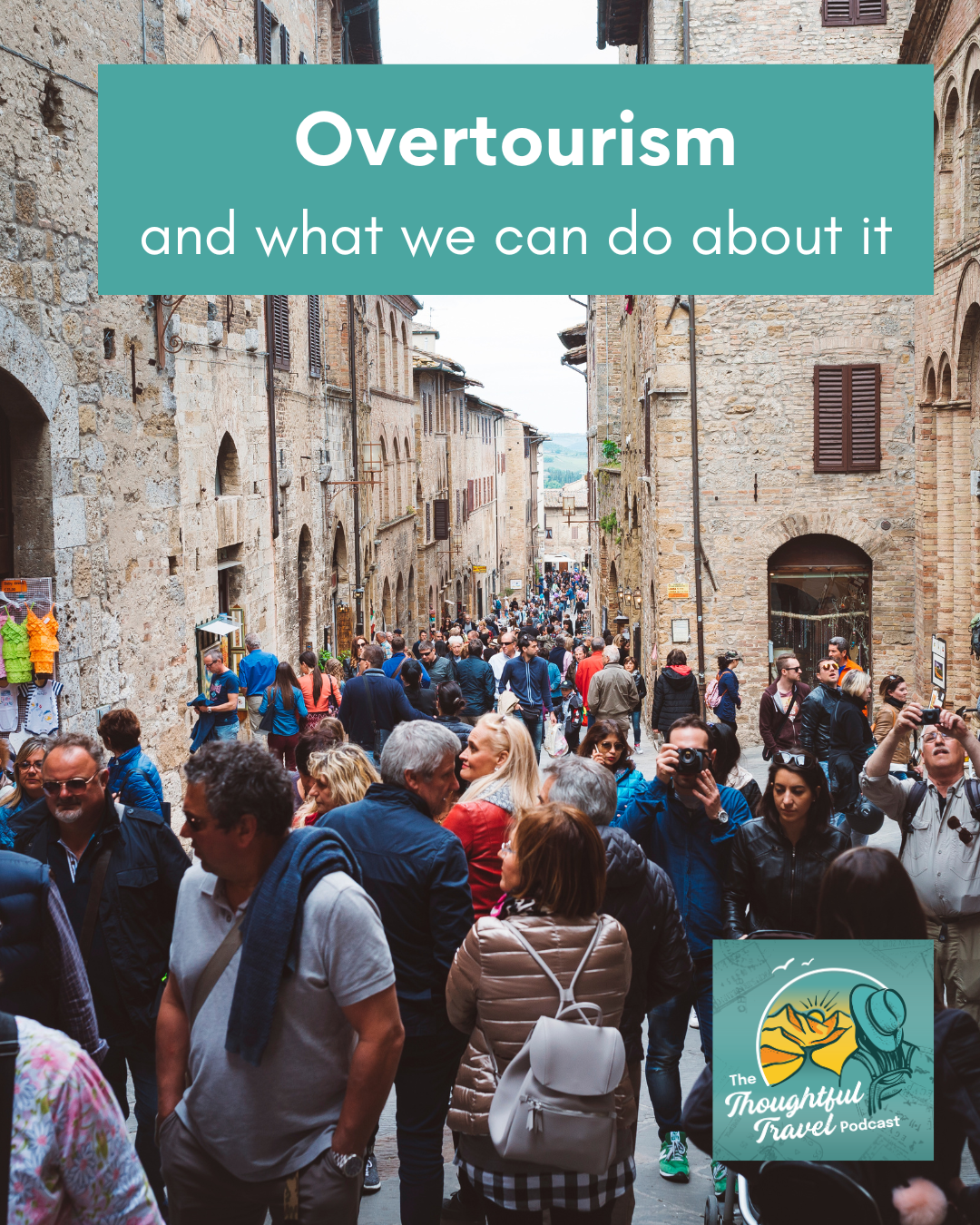
Can you imagine that we didn’t used to talk about overtourism? It’s really only a decade since this word entered common usage but it seems we hear about it constantly now. In this episode I chat with two guests who have great perspectives to add on this issue, and I also share some tips on how we can deal with overtourism as travellers.
First up, I chat with Christine Newell, who spent a year living in Seoul, South Korea, before it became a big deal on the international tourist radar. She talks about how it has changed over the past two decades and gives examples of mitigation efforts like curfews keeping tourists out of particularly affected areas.
I then speak with Bex Thomas, who started giving serious thought to issues like overtourism and economic leakage in tourism some years back when she and her friend made an effort to book locally to climb Mt Kilimanjaro. She highlights how being more mindful about our tourist time and dollars can also lead to a better travelling experience – win-win!
Finally, some tips on how we can deal with overtourism to both make our own trips better and impact the places we visit positively instead of negatively – drawing on my own experiences and a great blog post from Erin Hynes.
Links:
- Christine Newell
- Christine’s book Five Seasons in Seoul
- Bex Thomas – Sabbatical Stories Podcast
- Community Back Pocket
- Erin’s post on overtourism
- Erin’s post on economic leakage
- Episode 378 – Seoul Trip Report
- Join our Facebook group for Thoughtful Travellers
- Join our LinkedIn group for Thoughtful Travellers
- Sign up for the Thoughtful Travellers newsletter at Substack
*Full disclosure: Amazon Services LLC Associates Program
NotABallerina.com is a participant in the Amazon Services LLC Associates Program. As an Amazon Associate I earn from qualifying purchases.
Unedited podcast transcript:
Amanda Kendle 0:00
This is the thoughtful travel podcast. I’m your host, Amanda Kendle of the not a ballerina.com, travel blog. Every episode, I’ll share travel tales from several fellow travel lovers, and together, we hope to entertain and inspire you, remind you of some of your own great travel experiences, and encourage you to hit the road again soon you foreign Hello and welcome to episode 379 of the thoughtful travel podcast today. We’re talking about over tourism and what we can do about it. Firstly, let me pay my respects to the Whadjuk people of the Noongar nation, where I’m recording this podcast today in the middle of long, hot stretch of weather, not a fan of our of our hottest days, that’s for sure. But I know many of you are in much colder climbs, so enjoy them while you’ve got them. Now, back to over tourism. When I began this podcast back in 2016 over tourism wasn’t really even a word, which feels hard to believe. But if you look at Google Trends, for example, you can see people started googling it around 2018, 2019, and then, of course, when the pandemic hit in 2020, over, tourism became a bit of a buzzword, and we realized then about we saw all those, you know, beautiful videos and pictures of some places that usually had a lot of tourists who were which were faring much better without tourists. So from then on, the interest in over tourism has just gone up and up, and lots of people are searching for information about over tourism in specific places as well. I don’t think those places will be any surprise to you, the top searches in that over tourism space are for Japan, Bali, Amsterdam, Barcelona, Venice Santorini and Hawaii. So it didn’t surprise me, either, but it’s sort of sad, you know, state of affairs when I published an episode on over tourism around a year ago, that was one of the most downloaded episodes for that time. So back to over tourism, because it’s important in this episode, I’ve got a couple of guests with some more interesting perspectives to add to this topic. So first off, I’m going to chat with Christine Newell about her experiences with South Korea and how it’s changed over the past two decades. And of course, this is no surprise. Probably I did mention over tourism there recently in Episode 378 about our trip to Seoul. And then I’ll be speaking with BEX Thomas about how she learned about a related aspect of let’s call it tourism harm, which is tourism leakage, or economic leakage. That’s when a place can be getting masses of tourists, perhaps, but not actually getting many advantages from it, or even just just being harmed. And in the spirit of hope, I will finish up with a few tips on what we can do to help this whole situation. So hopefully both our own trips are more enjoyable and we’re doing less harm and more good to the places we visit. So Christine Newell, who, like me, spent time living in East Asia and working there about 20 years ago, still looks back fondly and has continued to return. So for me, of course, I spent a couple of years living in Japan long before overtourism hit. And these days, when I see stories about people visiting Kyoto or parts of Tokyo where the tourist crowds are just insane. It makes me a bit sad, I have to say. So Christine spent her time abroad, living and working in Seoul, and although South Korea doesn’t have quite the extreme reputation for over touristed areas as Japan, yet, it’s probably not far off. And we chatted about how things have changed over the years.
Christine Newell 3:41
You know, I read the other day that Australian visitors to South Korea, the number has increased by a third since 2019 which is which is huge. And I know when I go back and forth now. You know, when I first lived and worked there, there weren’t a lot of foreigners. There was an English teaching community, but so, you know, definitely an expat community. But it’s not like it is now. There’s a really big difference so, and I can only think that that has a lot to do with K, pop, K, beauty, all of those trends that are now sweeping the world. And also what we have access to with Netflix, we can now watch Korean dramas on tap, which is great for me. I absolutely love them. And, you know, Korean movies are starting to win awards, like parasite Minari past lives, and I think Australians and also people in other parts of the world are finally realizing what South Korea has to offer. You know, for me, Seoul in particular, there’s Gangnam, which is where I lived and worked, and you know, that’s famous for the nightlife, restaurants, cafes, designer brands, shopping, skyscrapers. But then on the other side of the Han River, you’ve got the he. Historic neighborhood of Insadong, where you’ve got the palace district, you’ve temples and shrines, traditional arts and craft. It’s a real a real foodie Haven as well, like the food is amazing. And, you know, I think people are just starting to realize that now, and I think there’s the excitement of discovering something that’s new, that was different. You know, until now, Japan has been the place to go. And, I mean, I know when you were there, it wasn’t as popular as it is now, but I feel
Amanda Kendle 5:30
like, yes, South Korea has been in the shadow of that, for sure, it has, and
Christine Newell 5:34
now it’s inching its way forward, and there’s so much to do there. Like, it’s easy to think that, oh, you know, Seoul is a city of 10 million people, so it’s just busy and chaotic. But, you know, there’s so much more of South Korea. There’s Busan, which is down on the in the harbor, on the water. There’s, you know, mountains, tea fields. There’s just so much to explore, and it’s great for hiking. But then you’ve also got that, you know, k pop, K beauty trend that I think the younger generation are really seeking out. So I think it’s becoming popular with with younger tourists
Amanda Kendle 6:11
as well. The Korean people are very, in my experience, very welcoming.
Christine Newell 6:15
They are very welcoming. Yes, look even, you know, I know Seoul really well, but I was there in July, and I was staying in a different area. It was very windy, lots of alleyways, and it was just really clear that the taxi driver had no idea where he was going. You know, he was so lovely, and I could tell he really wanted to help, but he just didn’t know what to do. So it was kind of a case of, look, here we are, around the corner, jump out, and I, just for the life of me, could not find my Airbnb. I was staying in a traditional hanok house, the old Korean homes, and it’s a very hilly, kind of windy area. And so I just, I was hot. It was the middle of summer. I was dehydrated. My water had run out, so I just kind of wandered into this shop and asked the the shop owner, and she was so lovely, she actually just closed her shop and walked me to my to my Airbnb and made sure that I was was safe. And, you know, and you know, every day I popped by and said hello, and we had a little chat, and now we follow each other on Instagram. Oh, lovely, very welcoming and very willing to share their pleasure and their food with you. Yeah.
Amanda Kendle 7:30
Oh, I mean, I had exactly the same experience when I went to Seoul, like 20 odd years ago. We must have come in on the train or something, where we’re at a big intersection trying to find our hotel, which is, like a little pokey, budget hotel, yeah, and it seemed, you know, we didn’t have smartphones, and we had, like, you know, where it’s somewhere here. And then we eventually, and because we had no Korean language skills, but we asked it a little kiosk, he wasn’t really sure, but he waved over like just a passing stranger and explained to them, because it was like a younger young woman, yeah, I guess he probably thought she might speak English, just, you know, it’s just a random strategy. She did speak some English, and he explained to her what we were trying to do. And then she took us and, like, it was like a 10 minute walk out of her way. But she took us until, you know, until she had trouble finding it. But then we found, you know, she helped us find it. And, you know, there was no need for her to do that, you know, I think that. I don’t think that would happen here.
Christine Newell 8:24
Yeah, it’s interesting, isn’t it? It is. There is a very different kind of way that they receive visitors and foreigners. So but again, I think that gets back to the fact that, you know, in the past, South Korea hasn’t been as popular for tourists, and you know, now they’re very willing to to welcome and they just, they they want to promote their culture out outside of Korea, and they want people to go away feeling like they’ve had a really positive experience. But that’s, you know, that’s also causing some issues now with over tourism as well. You know, even though the popularity of South Korea is kind of relatively new, you know, it is starting to really become an issue, and especially in those tourist hotspots where, like I said, where the hanok houses are and the palace district and the cafes and the bakeries are so popular with with the younger generation. And also, you know, Instagram now, there’s so many hot spots, Instagramable places where people want to get photos. And I know that in the in the bookchon village area, which is in the historic area of Seoul, they’ve actually had to put in a curfew, which is very recent. I you know, I’ve never heard of anything like that over there. I visited the area a few times, but I did notice last year, in July, it just had moved to a whole new level. I think, you know, part of the problem is that people don’t realize that, yes, this is a tourist area, and yes, these homes are old and historic, but people still live here, and a little older Koreans live there. They just felt like their front doorstep was just being taken over. And trampled I’ve over by, you know, crowds, hordes of tourists just want photos. They have actually had to put a curfew in place. And, you know, it’s, it’s quite concerning to think that, really, that confidence felt so uncomfortable in their own home. Oh, that’s really sad, yeah. So it will be interesting to see how that goes. And, you know, I hope we can find the happy medium.
Amanda Kendle 10:23
Yes, it’s very tricky, isn’t it, because it is so sad when you get and as you say, it’s often these kind of really Insta famous places, and people want to get the picture. And that really bothers me, because I think that’s not a really good reason to travel. There’s 1000 better reasons to go somewhere and learn about a place, to think it’s easy for people when they’re in that kind of Insta famous pursuit, to forget, yeah, this is somebody’s home. People live here. And imagine if you were in your home and there was these hordes of people out the front taking pictures.
Christine Newell 10:57
It’s awful, yeah? And it’s just the noise. And I just think the lack of realization that that this is someone’s home, and I think especially with the popularity of K dramas now, you know, there’s all those locations that people want to get those snaps, and that’s that’s amazing. And, you know, I’ve been in plenty of situations where, you know, I’ve really wanted to get a photo of a specific place, but it’s also just, you know about being mindful of where you are and what’s going on around you,
Amanda Kendle 11:24
absolutely not get caught up in the moment and be an unpleasant visitor. Yes, exactly. Yeah, that tourist curfew that Christine mentions is one I talked about briefly in last week’s episode on Seoul. It is actually the reason I intentionally didn’t go to that part of the city, I was kind of glad I could easily find that information and then choose to not be part of the problem. But of course, when places are that over touristed, they’re also not great experiences for us as visitors, either. So yeah, food for thought. Now, as I mentioned, my second guest is BEX Thomas, and she learned more about the impact we have when she was planning a trip with a friend to climb Mount Kilimanjaro,
Bex Thomas 12:04
this really started as I was starting to research climbing Kilimanjaro. I was on the plane down to a sales conference in Melbourne with one of my work colleagues and very good friend, and she said, Do you fancy climbing Kilimanjaro? And I said, Yeah, why not? And so we started to investigate. And I, up until this point, I hadn’t realized it really I’d done leisure and tourism as a degree. So I definitely studied some areas of regenerative tourism, responsible tourism, but I don’t think I intentionally had traveled as a good traveler, as a good human maybe, but certainly not as a regenerative traveler. I hadn’t explored and really gone into depth around that and she was very intentional on wanting to keep the dollar local when we traveled. Climb with a local company partner with a company whose story really resonated with us, and who the people really, really we felt a connection with. And so it was really the first time, and I thank her massively for taking me on this journey around that whole piece around responsible tourism and and spending locally. What I will say is it certainly took way more time to research. There were way more challenges around again, language, so English and the assumption that the individuals on the other end of the email could understand us and vice versa time with regards to, I don’t know, you book with an intrepid and it’s instant, or you probably get an instant response, or certainly within a few hours, you know, these local companies, they would take two days, three days, sometimes, to get back to us, because they’re busy trekking. Yeah, but then you sort of start the seeds of doubt, start to plant that you’re like, oh God, are they reputable? Are they? Is this the right thing to do? But we absolutely were committed to it, and so we did all of our research. We found a company called Kilimanjaro heroes who were phenomenal, and I would highly recommend, and it was two local chaps that had really come good and set up their own business. And honestly, from the moment we landed in moshi, they looked after us like just they were amazing. They were absolutely amazing. But it was from that moment that then I started to go down a rabbit hole around tourism leakage and how I think one of my values is, is equity and being equitable. And I thought, actually, this is something that there just isn’t enough talked about, written about, promoted about. I honestly believe that most. Humans are good and want to do the right thing, yes, but when it’s so easy to stay, I don’t know, at the Hilton in Thailand, or at the Mercure in Australia, then actually, we don’t scratch the surface, and tend to look at what doing that actually in the impact is so that’s where it started for me, and then when my husband and I took our sabbatical, our six month sabbatical, I wanted a project, and I wanted to prove to myself that I could do something that I’d never done before and that I didn’t think was possible for me, and I am a total tech Vogue, and I’m terrible at anything. It’s a real blockage for me. So okay, I thought, right, I’m going to build my own website, and I’m going to blog, and I am going to blog whilst I’m traveling. And what I want to do is I really want to promote tourism or advocate against tourism leakage, and really want to educate people around what spending locally means, how they can do that, and what the impacts are of not doing that. And so I set up my blog, which was called community back pocket, and it was all about that. So it was all about educating around tourism, leakage, regenerative travel, and highlighting and showcasing local options instead of multi national corporations. So that’s what I did. Setting up the website was awful, and still brings me out in hives. And I would never, ever, ever do it again. I would outsource that and pay somebody but the actual then writing and exploring people’s stories. So I, I had articles on there about places that we’d been, but I also interviewed people that I knew were local. So for example, there’s a wonderful lady, wandi, who we stayed with in Thailand, and she ran a guest house and a cookery school, and so it was just wonderful to get to know people like that and interview them and highlight their stories on the website perfect.
Amanda Kendle 17:12
And those are exactly the kind of things that help other people to follow those paths, because, like you say, when you’re looking when you’re doing the research on it, it’s much harder to, first of all, find places. And then there’s the seed of doubt, because, yeah, the Hilton or the Hyatt or wherever, you know you know what you’re going to get. You know, you’ll turn up and there’ll be something, and you get your confirmation immediately. So it is just that level of like, you just need a higher trust level sometimes to, you know, be confident to book with a more locally owned place. And so stuff like that. Kind of writing is so important, so people can go on and Google and find other people. Oh, yeah, they stayed there. Oh, it sounds great. It makes a huge difference. Yeah.
Bex Thomas 17:52
Especially, I think, when travel isn’t if you’re just thinking about a holiday, in comparison to, I suppose, traveling if you’re thinking about a holiday. These are periods of time where people really have, you know, saved for. They want to feel amazing. They the expectation is so high. So I get it. I do understand why. Sure, they go for luxury. They go for and the majority of that that have the budgets to be able to promote themselves and put themselves on a booking.com or whatever it is, such that, of course, that’s that’s what you’re seeing. But there’s a whole other world where, actually, if you take the time do the due diligence, you can get most of the time the same, but just with a little bit more research and time put into it.
Amanda Kendle 18:43
I mean, not the same. You can get better. Oh, give me a locally owned, lovely, little, tiny hotel over a generic, bland Hilton any day of the week, like those places.
Bex Thomas 18:56
Love it all, and it comes down to the people again, doesn’t it? Yes, you know the stories you’re going to get, the connections, the pride that they’ve got for it. If I think about Kilimanjaro heroes, the pride that those two boys had in their company, the stories that they had how they treated their porters, in comparison to the stories we’d heard around how other companies may treat their porters, the connections between them, the camaraderie was so obvious, and that love and that sort of support was so obvious and and we really were felt as though we were coached around how to treat them and what and almost get over ourselves as well. So a prime example of that is, and I’ve written it in the blog, I felt really uncomfortable towards the end of it, so the end of the trip, and what a lot of companies tell you about is the tipping, which, you know, fine, and there’s a lot online around the tipping, but what the two guys that ran Kilimanjaro hero said to us is no. The Tipping is fine, and that’s money. And, you know, you can read about that, whatever. But actually, what are you going to do with your, you know, dirty socks or your your trousers that you’ve been trekking in? And we were like, well, take, take them home, I suppose, I don’t know. And they said, Well, if you want to, you can gift them to the porters that. And we had, I think it was six or eight porters between us, all guys. So immediately our response was, Well, they’re not going to fit into them. They’re not. And they said, No. But in their villages, they’ve all got daughters, wives, aunties, mums, they’re like, oh my goodness, of course. And then, but they’re dirty and stinky, and they’re like, they’ll wash them, and it’s you getting over your own. I’m like, oh my god, I can’t possibly give this to somebody
Amanda Kendle 20:45
that’s all that was pile of my dirty washing, essentially, yes, but
Bex Thomas 20:49
honestly, the ritual then we had around them all, and they are so fair in how they then distribute it between each other. So it’s just beautiful. So yeah, I agree with you. You, you get more and better by traveling and booking local.
Amanda Kendle 21:08
So I think that these two stories together already give us a lot of ideas on how we can travel better. And I think by doing a bit more research and booking locally where you can you’ll already be avoiding some of the most, some of the biggest over tourism problems in parts of the world. But I also wanted to talk about a few other ways we can do better, some obvious and some not. Some of these ideas are from my own experience, and also some from a great blog post from my friend Erin of the curious tourism podcast. I’ll link to that blog post at pena travels.org in the show notes, because there’s much more than I’ll mention worth a read, but basically, some of the most obvious ways we can deal with over tourism as travelers are things like traveling outside of peak season whenever you can. So that might mean avoiding summer. Might mean avoiding school holiday periods or seasons like Golden Week in Japan or the Lunar New Year in many parts of Asia, and within your trips as well avoiding peak times of the day. So as an example, a lot of museums these days are open late into the evening and are heaps emptier then than at midday, when all the tour groups go through. So that’s also a great option. I have had some really lovely evening museum visits over the years. Also, of course, try to avoid the real tourist hotspots, that big bucket list places, or at least consider, do you really want to go there? Because I really believe a lot of people go to, you know, the parishes and the rooms just because they’re famous and not out of any particular interest. With a bit of research, you might find that somewhere else is much more enjoyable for you and the things that you’re interested in. So always like take that moment to have a second think. And another tip from Erin is to travel in smaller groups. So if you want or need to join a group tour, find small ones, so you’re not part of a big parade of bus loads of people suddenly landing on an area. And related to that, of course, avoiding large cruise ship travel, if you can, helps as well. Some of those places that have like, 1000s of people disembark for a day or half a day from ships, they really suffer. There’s actually often a lot of economic leakage in those situations. Most people don’t spend much money while they’re off the ship because they’re already paying for all their meals and stuff on the ship. They don’t want to spend too much extra money, or they’ve paid for tours that you know, not necessarily having much of that money go into local local organizations. And of course, those hoards really disrupt daily life, especially when they land in a small place. And as BEX mentioned, every time you’re able to make sure your tourist dollars are going to a locally owned business, you are also reducing the impact of over tourism as well. Sometimes it’s harder to find that out, but it’s often worth a Google or a quick question. So lots of food for thought. I must say, when I see some of the horrific photos of the crowds at over touristed spots these days, I actually can’t imagine why anyone wants to go there, no matter how amazing it is. I think the world is a huge place. There are many, many places you can enjoy without having to be stuck in a massive crowd of other tourists. So thank you so much for listening to Episode 379 of the thoughtful travel podcast. A big thanks to my guests. Firstly, I chatted with Christine Newell. More about Christine at Christine newell.com and I do recommend highly her book five seasons in Seoul, which is about her experiences working and living in Seoul. Super interesting. And I’ll leave a link to that also thanks to BEX Thomas from the sabbatical stories podcast. Find that at BEX thomas.com/podcast and also the website she mentioned has some interesting info on it, community, back pocket.com, and as promised, I’ll leave a link to Erin’s post on over tourism. And I’m also leaving a link to my soul Trip Report Episode 378 of the podcast, because I’ve referred to it a few times. Don’t forget to come along and chat in the Facebook. Or LinkedIn groups for thoughtful travelers, and join us on substack at thoughtful travel.substack.com all of this info and more at the show notes for this episode. You can find them at not a ballerina.com/ 379, as always. Thank you so much for listening. You
This has been another episode of the thoughtful travel podcast. Show Notes and other information are at not a ballerina.com/podcast join me again soon for another chat about why we travel. Bye for now.

Leave a Reply