I have made such lovely connections with all manner of people through my travellers: with locals I’ve randomly met, with fellow travellers, with guides, you name it. It’s a particularly special part of travelling, and this episode highlights some wonderfully interesting connections made by my guests. Enjoy!
Show notes: Episode 258 of The Thoughtful Travel Podcast
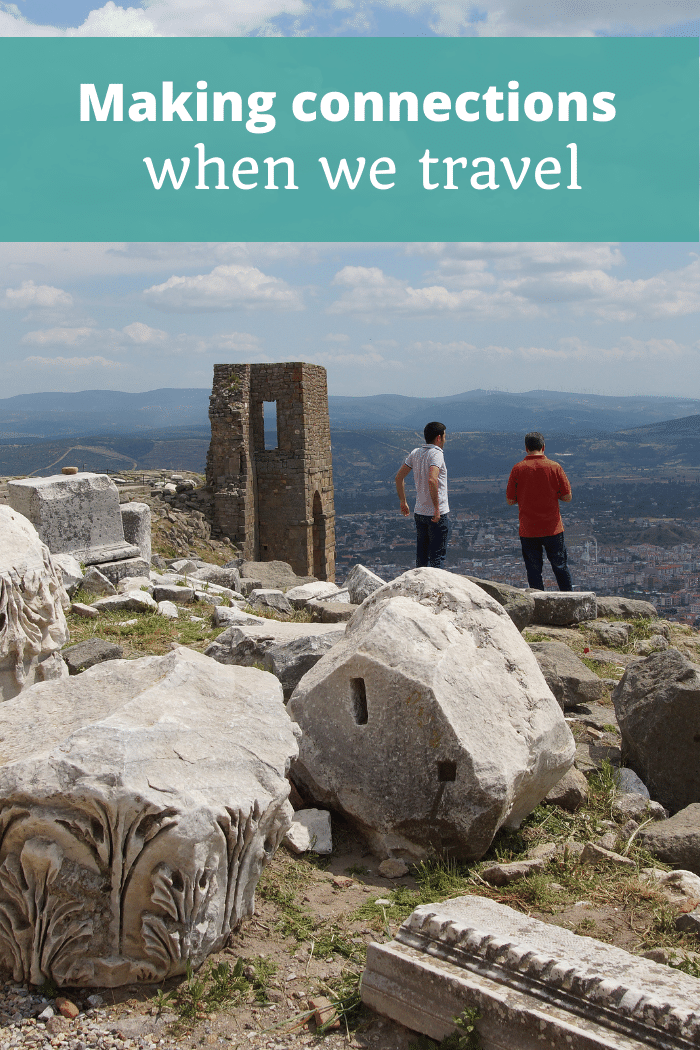
Making Connections When We Travel
Getting to meet all kinds of people is one of the best parts of travelling and this episode is full of stories of connecting with people in all kinds of different ways. First up, Kate Peterson tells an amazing story about both her parents’ connections with a Greek man back in the 1970s, and her follow-up explorations when she lived in Greece decades later.
I then chat with Tobi Barth, who takes people on tours to see the northern lights in the Yukon, about a special connection he’s made from this work. Finally, Lindsay Williams explains a lovely connection made quite randomly in Cuba on a muddy walk that turned into something very special.
Links:
- Kate Peterson’s Art
- Kate’s travel journal Around the World and Back Again
- Tobi Barth of Epic North
- Lindsay Williams of Lindsay Does Languages
- Join our Facebook group for Thoughtful Travellers
- Join our LinkedIn group for Thoughtful Travellers
Transcript
Amanda Kendle 0:00
Hello, and welcome to episode 258 of the Thoughtful Travel podcast. This one’s all about making connections when we travel. And for me, the kinds of people that we get to meet and get to know when we travel. That’s really one of the absolute best reasons to travel. And I have, in my mental catalogue of people, I’ve met just so many wonderful people that I’ve come across in various ways when we travel. And those are the kinds of stories I want to highlight from three excellent guests today. Now, I won’t jabber on for too long, because my guests’ stories are relatively long. So I’m gonna dive straight in. And my first guest today is Kate Peterson, and she told me this beautiful story a couple of months back, it’s kind of a cross-generational story about making connections when we travel. And I’ve been in touch with Kate since this chat, and I recently learned that her dad passed away, sadly earlier this month. And he features very boldly in this story. I know he was also a big inspiration behind Kate’s love of travel. So Kate, I just wanted to say I’m thinking of you and your family. And I love that we can share this delightful story that I know your dad loves to tell about making connections when we travel.
Kate Peterson 1:46
This is the story of Konstantinos Bastoonis. It happens to be another Greek story, but it starts when my parents were in Greece. So in the 1970s, my parents went on a long backpacking trip throughout much of Europe, which of course became the source of many of their best travel stories. And my dad in particular is just a phenomenal storyteller, especially because he’s travelled all over the world. So he’s the kind of dad who has a packaged set of great stories, which you hear over and over and over again, but it doesn’t matter at all, because he tells them so well that you enjoy them every time.
So one of his most famous stories was about a man my parents met while they were travelling in Greece, whose name was Konstantinos Bastoonis. They were in the Peloponnese in 1973, and they were on their way on foot to the ruins of a temple, which is called the Argive Heraion near Argos. And I can’t tell the story quite as well as my dad, but I actually do have his journal entry from that day, which I’ll read excerpts of here.
Amanda Kendle 2:51
Oh, gorgeous!
Kate Peterson 2:53
So okay, this is what my dad wrote: we met Konstantinos Bastoonis today, and it made this day into one of the most beautiful of all of our travels. He knew not a single word of English, and we knew hardly a word of Greek. So our communication was very slow and simple. However, Konstantinos communicated some very important and beautiful things about himself to us, and we had a good time together. At this point, my dad describes a bit of what they saw as they were walking with their packs down the road on the way. And then he writes: we continue walking down the road, but soon stopped to cool off a bit. Sitting in the shade we hear singing down the road away, a haunting Greek folk tune. Then we hear another voice pick up the tune in a deep bass. We stare down the road expecting to see a young woman and a man. But in a moment, a lone, old man on a tiny donkey comes around the bend, singing both parts. As he approaches Mary – obviously, my mom – asked if she can take his picture, he emphatically indicates that that will be fine and stops directly in front of us. After the picture is taken. He gets off the donkey and wants to know where we’re from, where we’re going, et cetera. He also tries to tell us something else. Finally, we realize that he wants us to send him a copy of the picture. We of course, agree and he writes down his address for us. Instead of continuing along his way, however, he indicates for us to come with him and he sets off in the direction he came from. We follow him down a little path along the edge of a field. What will we soon see, Constantinos has brought us to an ancient tholos collapsed and generally not so spectacular as the tomb of Agamemnon, but quite something. Nonetheless, Constantinos insists that Agamemnon is buried here and indicates one of the partially excavated shaft graves. Evidently, Agamemnon is buried everywhere around here. And this part of the journal entry always makes me laugh because it’s something I myself experienced so much when I was in Greece, if you ask anyone about ruins, or where a famous thing or person is buried, you’re gonna get a dozen different answers. It’s so confusing and just absolutely wonderful. I really love it. So the journal entry goes on to say: we start to say goodbye to Constantinos. But he indicates for us to come with him again. We go up the hill to a little church. He takes us inside and shows us a plaque that has his name on it. Then he takes us outside and shows us a cinderblock structure with another plaque. Constantinos points to the plaque then crosses his arms over his chest, makes a sweet smile and closes his eyes. Suddenly, the meaning of all this becomes clear. This is his tomb and his plaque for over the opening. Next, he takes us inside his tomb and shows us the interior where there is a chair, a lamp on the wall and several religious pictures all carefully arranged. He indicates that now he reads his book in there. In all this, it is clear that Konstantinos is very aware, very joyful and very proud of all of this. Konstantinos takes us to a nearby door in the same cinderblock structure and shows us where he sleeps within five feet of his future grave. At a little hut, a few yards away, Constantinos goes down into the cellar, and draws retsina out of a huge keg for all of us, which he serves to us with olives. And at this point in the story, it eventually became clear to my parents that Konstantinos wanted a second photograph, but this one to be more carefully set up and arranged as more of a portrait. So my dad writes: Constantinos takes us back to the church and carefully prepares the scene, he props up the empty coffin against the altar, sets his chair in front of that and places the first plaque on the floor in front of him. He looks seriously and solemnly into the camera. Afterward, we again exchange addresses and then go outside, Constantinos walks us down the road, we shake hands and say goodbye. So that is written by my father, Norm Peterson, in September of 1973. And there’s a postscript that says: We mailed him the photographs after we got home to Colorado, but we never knew for sure whether he received it. So this story, which I grew up with, my dad telling, is so remarkable in so many ways. First of all, I mean, it’s incredibly Greek, right? So there’s the singing, there’s the donkey, the retsina, there’s Konstantinos taking it upon himself to be a generous host, and spontaneously deciding that whatever he was doing before was far less important than showing these random travellers all around the ruins. Just everything about it. And I always loved the story as a kid, you know, with the singing and the donkey and everything. But looking back on it now that I’ve had the opportunity to live in Greece, I understand just how quintessentially Greek this experience was. And I’m really happy my parents got to experience that.
And then second, of course, there’s the sense of being that comfortable with death, which few individuals – certainly very few Americans, or individuals from many other cultures around the world – would dare to even think about. I honestly don’t know if it’s more cultural, or if it’s just on an individual level for this one man, or maybe a mix of both, but building our own tombs, having daily contact with our own future coffins. I mean, all of it is pretty far from what most people in my culture, at least, would consider to be normal or desirable.
Amanda Kendle 8:11
Yeah, probably very healthy.
Kate Peterson 8:13
I mean, there’s something so admirable in it, right? I think if we were all so comfortable with the idea of our own death, it’s possible we would all lead happier lives, you know?
Amanda Kendle 8:23
Yeah. I mean, it’s not good to be scared of death. I think that’s true. And so obviously, this guy wasn’t.
Kate Peterson 8:30
So when I found out I would be coming to Greece, I knew that I had to find this tomb, because it’s such an important part of our family lore. So I took a trip from where I was living in Thessaloniki, down to the Peloponnese. And from there, I knew that half the challenge was going to be simply finding this set of ruins because it’s a pretty obscure place, that doesn’t get a ton of visitors. So when I arrived by bus, I approached the first taxi driver in the stand, and I asked in Greek if he knew where the Argive Heraion was, and he clearly had no idea what I was talking about. So I repeated my query, and he told me that he was from Argos, and he still had no idea; had never heard of it. So he asked a few other taxi drivers, and none of them knew until finally the fifth person he asked, knew where it was, and gave my driver directions for like, a full two minutes as I’m standing there wondering, you know, how far away this is and how long it’s gonna take. And so my cab driver didn’t speak any English at all. So when he asked me why I was going there, I braced myself for a long and difficult test of my Greek.
Amanda Kendle 9:35
Tricky to explain in a foreign language.
Kate Peterson 9:37
Yes, especially when you don’t know how to say anything in past tense and you’re telling a story from 1973. So I think I ended up saying something like my parents come here. They have a friend, the tomb of the friend, is there. I go to put flowers on it. So he nodded. He seemed like he understood and we drove on. But naturally after hearing what I had just said he drove me to the cemetery in the closest town. So at this point, I had a bit of a facepalm moment, and then I was really embarrassed, honestly. So I had to again explain in my terrible Greek that this was not what I was looking for, and that the tomb was at the Argive Heraion site itself, you know, as politely as I possibly could. And the taxi driver just totally lost his patience. I mean, here’s this random American girl with red hair, terrible Greek, clearly has no idea where she’s going, or what she’s doing…
Amanda Kendle 10:30
A weird request…
Kate Peterson 10:31
But it has something to do with a tomb, question mark? So he starts yelling in Greek, and then kind of begrudgingly drives on while I’m in the back having no idea if we’re now headed in the right direction. But within a few minutes, we had indeed arrived at the actual site. So victory.
Amanda Kendle 10:48
Oh, excellent. Okay. So far, so good.
Kate Peterson 10:51
So my dad’s instructions were to find a small church, which the tomb would be behind. And I couldn’t see any church at all. I walked around for a bit, still no churches. So thankfully, there was an attendant and a little wooden booth. And I walked over and greeted him and told him that I was looking for a tomb. And he said, Oh, do you mean by Stunius? And I said, Yes. Oh, my gosh, yeah. How did you know? And what he said was ‘Ela!’, which is the Greek equivalent of ‘come on!’ How could I not know about Stunius, and I looked at him in disbelief, starting to wonder who Konstantinos really was, and how much more there was to the story than could be communicated with the language barrier between him and my parents, and a thousand other questions. And the attendant thankfully explained to my taxi driver, and much better Greek than mine, where we were going, and then walked me to the tomb himself, which- as I think about it now – is another really lovely parallel between my parents’ journey and mine; these incredibly generous Greek hosts, taking time out of their schedules to show us around and help us have a meaningful experience. So the attendant’s English was kind of so so, but obviously, my Greek was too so we sort of met each other halfway and I was asking him questions about Konstantinos and he told me as much as he knew, and it sounds like Konstantinos was quite the local legend. The site attendant used the word mythos to describe him. I told him, my parents were here in 1973, and that Konstantinos was very kind to them. And what he said was, ‘then they will be very sad that he died in 1975. And his death, it wasn’t natural’. So I stared in shock, as he told me that Konstantinos was murdered just two years after he met my parents. The attendant couldn’t be completely sure as to why, because it took place a long time ago. But he said that the locals in the town, say that Konstantinos found some ancient gold coins while digging on his farm, and that some people killed him in order to take the coins.
Amanda Kendle 11:09
Oh, that’s a tragedy!
Kate Peterson 13:00
Horrible. So I’m taking in this heartbreaking story, and imagining telling my parents what I found out. And that’s when we come upon the church that we’re looking for. And as promised, the little white stucco tomb behind it. So I made sure to thank the attendant profusely for his time. And then I carefully arranged some flowers on top of the tomb, which was, sort of all I could do at this point. But at that point, it felt like enough in its own small way. And I stood there feeling really overwhelmed with gratitude for the kindness that this man had shown my parents and for the fact that I could then return to this place where he’s buried and commit even this tiny, small kind gesture, in return, about 40 years later. I mean, it’s a crazy story…
Amanda Kendle 13:50
I have goosebumps. That it is a crazy story.
Kate Peterson 13:53
One of the most amazing things about travel as a whole, but I think Greece in particular, is, I think is you really can feel like you’re able to skip around the centuries, just as if you were like diving into a pool in Greece, right? Because you’re surrounded by these ancient Marvels everywhere. And I think being able to do the same thing on just a little micro scale; a scale involving my family and one man from Greece, it felt like even a more powerful way to skip around in time and bring that story full circle for my parents.
Amanda Kendle 14:29
That’s one of my favorite stories in ages. So thank you, Kate, for telling it so beautifully. Now, our next story about making connections when we travel today comes from Tobi Barth who is a tour guide in the Yukon, and we talked about some of the amazing connections he has made through this fabulous job he has, which includes often taking people out to see the Northern Lights.
Tobi Barth 14:52
When you travel, you make friends. So most of the time – especially for us – we love talking to people. We love talking to the locals and get a little bit more insight about the place you go. And so there are a lot of good connections still from earlier, from 10, 15 even 20 years ago from our travels. But now since we are offering tours, and we have exactly those people travelling [who] want to make friends, want to connect to locals. There’s one specific guy and his name is Paul. He’s from Australia. And he went on one of our tours twice, two years ago, and we had exactly the situation that the first night was… we were not lucky, we didn’t see the light because the weather was simply too cloudy. I think it was really heavy snow as well. And so it was a nice night, and they were super happy. We talked a lot and you know, you have so much to talk about, it was a small group, I think it was a group of six. And four of them were two couples from Australia. Those two guys were friends, or those four guys. And the other two were from Mexico, it was a really nice experience. These talks, you think, ‘Oh, wow, that was such a good night’. And so the Northern Lights were just a side topic, right? Because it was so interesting to talk to the people. And the next day, they went on the tour again, and it was a perfect night. It was one of the best nights in this winter. And and so we did some recordings, you know, time lapses with the GoPros, and a lot of photos. I showed them how to take the pictures, and we did a lot of photos with this group. The day before was not successful, but the next day was so good. It seems like it was destiny for them. And since then, Paul keeps on writing texts and emails to us and talking about the poor and asking us how are we doing during this COVID thing. And he sent us his videos and pictures and he was so happy, the whole group of these four guys were so happy and they keep on sending this text and inviting us over to Australia, and they want to come back to the Yukon because they enjoyed it. And they wanted to come for a summer holiday, actually this year, in 2020. And so I hope they can make it next year or even the year after. And, you know, you’re in contact and you don’t feel that it’s a client or a guest of your company. You feel like it’s a friend because you had such good talks and such good discussions and it was a warm and friendly experience. And that keeps you happy even if you don’t have these guys every day, right? You don’t have this guest every day who are this is nice and interested in your life as well. Because they simply love to know: how can you survive in the Yukon? You have minus 40 centigrade, right? So how can you survive and it was a cold night, it was a night with minus 35. And it’s hard for people who never experienced cold like that, to go out there. And it was really interesting, we gave them the tips – how to keep your feet warm, and how to keep your hands warm and so on. And, you know, this is the experience; you don’t have them ten times a year. You have them probably once or twice a year, when you’re lucky.
Amanda Kendle 19:01
I definitely hope Tobi gets to catch up with Paul one day perhaps out here in Australia. It reminds me a lot of my friend Cham who I know I’ve mentioned before on this podcast, he’s actually been a guest a few years back and we met him when he was our tour guide in Cambodia. And we’ve since met up in all sorts of places and holidayed and traveled together. So I think you’re predisposed to making friends with people when they’re like-minded travelers; it can be the start of some fabulous friendships and great connections. And even if you don’t become friends, just being able to find out more about local ways of life by chatting away with a great tour guide is a pretty special thing to do. Now my final guest today is Lindsay Williams. And she has a story to tell about the people she met traveling around in Cuba.
Lindsay Williams 19:55
In Vinales, the place we were staying was right at the end of the town so we had this view every morning of just looking out over these – what are called mogotes – which are like… lumpy hills is the only way to describe them because it literally goes up and down, and then flat and then up and down. Very visible hills, like huge stacks of straw or something. So it’s a real kind of cavey place, lots of rock climbing, that kind of thing, horse riding. And so anyway, you just have this beautiful breakfast every morning and after a couple of days of meandering around the town and doing a couple of tours and things like that we thought, Okay, let’s go and see that cave on our own. I can see it on the map. It’s not very far, let’s walk it and see if we can make it to that cave. So we do walk up… gradually, further and further away from the town. And then gradually getting muddier and muddier and muddier as well. So I think, ‘okay, good. Keep going’ and you very tentatively go to the sides of the pathways which are a little bit more solid and round and round. And then I lost my shoe in the mud because it just pulled it off. It was so thick, I’m having to grab my shoe still balancing like in the most intense yoga… mud yoga – that should be a thing.
Somehow, out of nowhere, it says ‘Jugo’ (Juices). And we’re like: Yes, that’s what we need right now. Not so much the juice, more the human that’s probably there so that we can say ‘where are we… and how do we get there, not muddy?’ So we’ve got this sign and take a little detour down this other track. And then we see this shed, and we think: that must be the Jugo, that must be the juice shed – let’s go there. So we arrive at this shed – and by this point, my shoes are in my hand, both of them. It was much easier than trying to battle with the mud – and this guy comes out of the shed. And then these two other guys follow him and they come out, and there were some buckets of water and they’re holding them out for us to wash our hands and clean the shoes off. And we’re like, ah, gracias, gracias. And we said: We’re trying to get to this cave. Do you know how we can get there? Oh, si si si You just gotta go dum dum dum…. And we were like, Oh, is it muddy? Ha ha ha yeah, it’s muddy. Okay. And he’s like, Well, I can take you if you want. And we’re like, but are you sure? He’s like, I’ve not got much work to do. And we’re like: oh we’re happy to pay you, however much you want. I don’t mind. And you could tell this guy was completely legit. He wasn’t there to scam tourists or anything like that. He was just a farmer, a Cuban farmer. Didn’t care for tourists, was just happy to give us a day because he had some free time. So we were like ‘okay, yeah, sure’. And he’s like, Can you ride a horse? And I’m having this conversation in Spanish. I’m thinking I don’t know (laughter) do I translate this honestly? Because the one thing on this trip my husband had said he didn’t want to do is ride a horse and whitewater raft. So I thought, Okay, I better be honest, because in a minute, he’s going to be thrust upon a horse and realize. So I said, Oh, you don’t want to ride a horse, do you? He’s like, No, that’s okay. I was like, ‘we can’t ride a horse. But I see this car ahead, can we go in the car’. He’s like, alright, yeah. So we get in the car. And he’s at the front of the car, kind of getting the horse in front. And he stopped off at the tobacco hut and just made himself a cigar. And then we go on some further and he stops off at this cafe that must have been the place where this Jugo sign was pointing to. And this guy – not the horse guy, this other guy at this cafe in the middle of nowhere – just then starts talking to us through that process of coffee and making a drink. And then eventually we arrived at the cave. Now, this wasn’t exactly a tourist cave: there was no way to get there. The way that we got there on this horse – which at some point, the guy had had to get off the horse with his machete and trim down the path to get through – was the only way to get through, yet as we arrived, there were two guys there ready to take people into the cave.
Amanda Kendle 24:50
No way.
Lindsay Williams 24:54
And he says, Oh, hey, it’s $2 to get in a cave. We’ve not come this far, to not go in the cave. So we paid the guy who takes us in, shows a couple of stalactites and stalacmites. And then at the end of the cave was this Cave Lake. And he said, Well, there you go. That’s it. You can take off your clothes. There’s no fish. It’s about 11 degrees. Have fun. Okay, we had swimming costumes on, so I didn’t need to take off my clothes. Okay, brilliant. So down to swimming costumes we go, in the water, and it was just us. And this guy had meandered off to the entrance for a bit and we were just there on our own, in a cave in the middle of Cuba. No idea, the luck of how we got there. How did this happen? You know, and it was just an absolutely magical day. And it really sums up what it’s like to travel in Cuba, just the pure connection – people aren’t there – of course, some people are – but people just aren’t interested in ripping you off: ‘Like, oooh, tourist!’ It’s just like, ‘oh, yeah, hey, let’s go’.
Amanda Kendle 26:05
Another fabulous connection made while traveling. And of course, being open to all of these different connections generally makes your trip way more interesting and way more fulfilling, doesn’t it? So I think something to keep in mind. So anyway, thank you so much for listening to Episode 258 of the thoughtful travel podcast. Big shout out and thank you to all of my guests today. First up, I chatted with Kate Peterson. We also chatted with Tobi Barth and lastly, I chatted with Lindsey Williams. The show notes are at not a ballerina.com/258. As always, thank you so much for listening. Join me again soon for another chat about why we travel. Bye for now.
You might also like:
 Taking Photos of People on Your Travels – Episode 57 of The Thoughtful Travel Podcast
 The Kindness of Strangers on Your Travels – Episode 76 of The Thoughtful Travel Podcast
 Talking to Locals When We Travel – Episode 122 of The Thoughtful Travel Podcast
 Meeting Kind Strangers: Episode 242 of The Thoughtful Travel Podcast
Leave a Reply