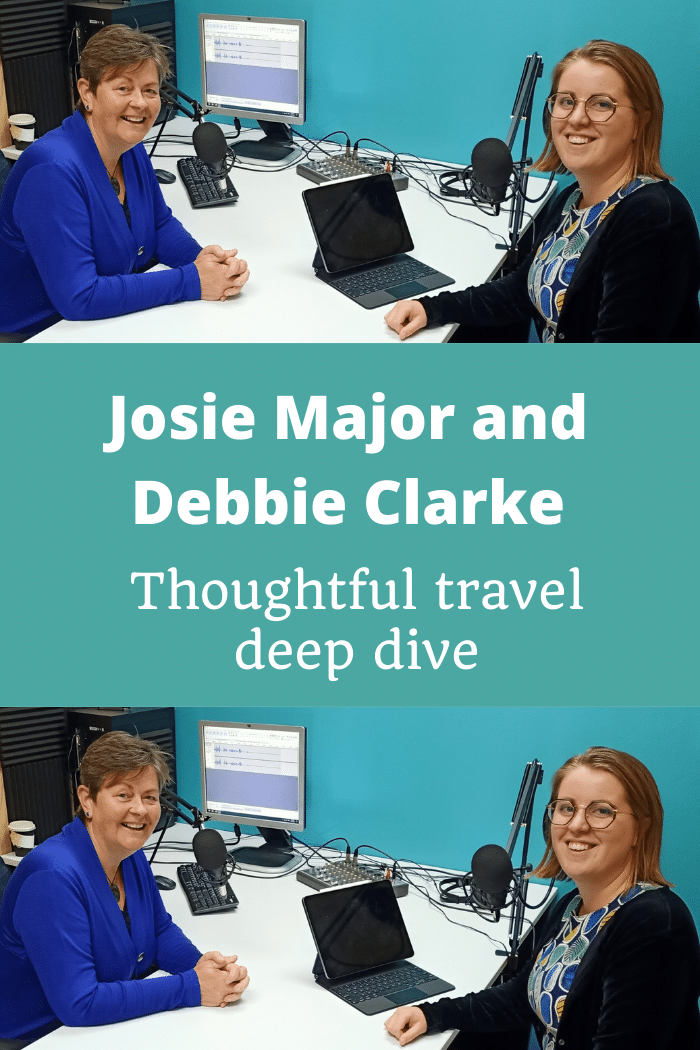
Best to start with the confession I gave to Josie Major and Debbie Clarke when we recorded this episode: I’m an Australian who’s never (yet) been to New Zealand. These two women call Aotearoa home and although I absolutely want to visit, it just hasn’t happened yet – to be fair, Western Australia is pretty far from Australia’s neighbour and it’s significantly faster and cheaper for me to get to Asia.
Confession aside, I had such a wonderful time chatting with Debbie and Josie, the two fabulous women behind the GOOD Awaits podcast, which focuses on regenerative tourism – something I am very into! Hope you enjoy listening as much as I enjoyed recording.
Show notes: Episode 262 of The Thoughtful Travel Podcast
Josie Major and Debbie Clarke: Deep Dive into Thoughtful Travel
It’s time for a deep dive and I absolutely loved getting to know the two women behind the GOOD Awaits podcast – New Zealanders Josie Major and Debbie Clarke. Their podcast arose from an almost chance meeting and focuses on regenerative tourism, something that aligns very closely with thoughtful travel.
During the chat, I asked Debbie and Josie about how their love of travel began and what sustains it to this day. We also talked about their current work and especially focused on how they think travel and tourism need to change to face some of the dilemmas of the twenty-first century. It’s definitely not all doom and gloom and I finished our conversation feeling really hopeful.
Links:
- GOOD Awaits podcast
- Josie Major of GOOD Travel
- Debbie Clarke of New Zealand Awaits
- Join our Facebook group for Thoughtful Travellers
- Join our LinkedIn group for Thoughtful Travellers
Transcript
Amanda Kendle 0:00
Hello, and welcome to episode 262 of the Thoughtful Travel podcast. This episode is a deep dive episode, I’m chatting with Josie Major and Debbie Clark of The Good Awaits podcast. Now, I must confess in the typical way that the internet often works, I actually cannot recall how I first came across their podcasts. But I do remember being very excited when I did. Their podcast focuses purely on regenerative tourism, which is which is something very closely aligned with thoughtful travel. And in fact, I have a whole episode on regenerative tourism and regenerative travel coming soon. So you will know more then. But for now it’s enough to know that Debbie and Josie talk about a lot of really interesting ideas. And after listening to most of their first season of their Good Awaits podcast, I knew I had to have them on here. And it was a real pleasure to chat with them. They’re both over in New Zealand. I started off by asking them how they had originally met.
Debbie Clarke 1:30
So we met in September 2020 at a tourism design challenge, like a weekend hackathon where we had pitched this idea about regenerative tourism; and how do we define that and how do we measure it. And Josie came in with good travel saying, Yeah, we’re really keen to try and explore that idea – you know, in a weekend completely unrealistic. But if you know anything about hackathons, you’re under pressure and you’re trying to create this prototype and present it into a pitch. And so I think Josie and I realized very quickly that we had wonderful energy and synergy, and very quickly just fell into this really easy working relationship over the course of that weekend. So yeah, it was fantastic. And this is what’s come out of it, is this collaborative, you know from Good Travel, New Zealand Awaits, and Good Awaits the podcast, and some other projects. It’s very exciting.
Josie Major 2:28
We’ve actually only met in person the one time, which is quite bizarre considering how closely we’ve worked together for the last year. We’ve only spent a couple of days together in person which is the world we live in now, hey.
Amanda Kendle 2:43
It is indeed a world now where the boundaries of knowing people online mostly, and in person a little versus really knowing them in person. They’re very blurred, and I actually lose track of who I’ve so-called ‘really met’. So I’m not surprised that Debbie and Josie are able to put together this podcast and clearly have a close working relationship without having to spend too much time in the same room. So we know where they have ended up, but I actually wanted to go back to when they began traveling. And so I asked them each to describe the roots of their love of travel. And Josie kicked it off.
Josie Major 3:22
This question made me very wander-lusty thinking about it, because it’s been a while since I’ve travelled. I’ve been really fortunate to travel a lot in my life, particularly as a kid. I was traveling as a small child with my parents, so I had lots of adventures that I can’t remember, which is unfortunate. But one that’s really memorable for me was when I was about 10 years old. My parents and my two younger siblings and I all went to India together. We had a cousin that was living there. And we spent four weeks exploring and as you can imagine, as a child, India was just overwhelming and amazing. People say about India, that it’s an attack on the senses. And I love that, because that’s completely what I fell in love with: the colours, the saris and kurtas and the sounds and the markets and the smells and the tastes. And so I completely fell in love. And then I returned to India when I was 21, on my own and as a backpacker. And that was interesting to go back with all these childhood memories of what it had been like, but this new kind of awareness and became quite quickly aware of the way that I was interacting with people, with the environment, with poverty, with host communities. And so that was the beginning of my awareness of my impact as a traveler as well, and how I ended up working with Good Travel, was at that time.
Amanda Kendle 4:59
You alluded to some of the reasons but why does your love for travel endure? What do you get out of it?
Josie Major 5:05
I really see tourism as a connector, I think it has the power to transform individuals, but more so to bring people together and create connections. And I think, with the challenges that we’re facing now, which are increasingly global ongoing sort of conflicts, as well as COVID-19, climate crisis, biodiversity crisis, and the social and political division that we’re experiencing at the moment, I see all of that as products of the disconnect that we have from each other and from nature as well. And so I guess my love for travel[ling] and its potential to be a part of the solution to those things, in terms of the way that we can act as global citizens, that we can understand each other across cultures and the power it has in terms of storytelling as well, stories of place and other people’s lived experiences, which, if you start to understand other people’s lived experiences and that can build sort of connection where there was divisions.
Amanda Kendle 6:15
Yeah, interesting. We’ll definitely dive deeper into that. But Debbie, can you tell us about how your love of travel began.
Debbie Clarke 6:22
So my first travel experience was actually with a swim team to Brisbane, when I was about 13 or 14, and even though we’re so similar in our cultures, we’re still very different, right, Australia and New Zealand. And so I remember having fresh pineapple and fresh mangoes and I’m like, Oh, my God, what is this country where you can eat fruit like this? And then, of course, being a typical Kiwi or Aussie, we all have the the big overseas experience, which I did when I left uni. And that was really amazing and transformative for me, and I know that word’s overused, but it really was because I was in my 20s. It was a time when… I feel very thankful that it was a time where we could… I backpacked through the Middle East Syria, Jordan, Egypt. I know, it’s just amazing to think about now, the places that we went, and it was myself and a female friend, a girlfriend, and that we were backpacking through those places, and hitchhiking and being invited into people’s homes. And so having those incredible experiences with locals really shifted how I saw the world growing up on a farm in New Zealand; I was very insular, privileged, upbringing that I didn’t realize, until you go to some of these countries. And like Josie said, you see poverty and you see the way other people live. And I wasn’t as aware at that age of my impact, as I would hope that I could be now when I travel. But it certainly did shape my thinking of… when you when you’re interacting with people, and you’re engaging with people, even if you can’t speak the same language, that joy that you have from sharing, whatever it is, whether it’s their local food, or they’re taking you to their local places, and as a backpacker back then – you know, we’re talking 30 years ago – you could really do that. And it was magical. It was just magical, that you had these opportunities where you were invited into people’s homes, and I was invited to be the the fourth wife of a Jordanian man who wrote me letters for years afterwards. I mean, that sort of stuff is just…
Amanda Kendle 8:31
Oh imagine if you’d said yes!
Debbie Clarke 8:36
I politely declined. But yeah, incredible experiences that I will always treasure and feel so privileged to have had.
Amanda Kendle 8:46
You both mentioned the connections and meeting people, and I think that’s such an important part. Often the glossy travel brochures show you the Eiffel Tower or the Colosseum, and they don’t really show you what it’s like to meet local people, or just to meet people who have a different life experience to you. And the power of that – I always flippantly say – is if everyone traveled more, there would be world peace, because we would all… it’s a very utopian concept, because if you just understand people by having met them and talk to them and being in their houses, it’s just so different, isn’t it? And Debbie, why does your love of travel endure today?
Debbie Clarke 9:28
For those same reasons, that we’ve just been talking about – that it is the power of travel, that it has the ability to shape, to shift our perspective and to shift how we see the world and to open our minds and to show us new ways of living and being in the world.
Amanda Kendle 9:47
I’m pretty impressed that Josie – well, Josie’s parents – took her to India when she was 10. I actually contemplated taking my son to India when he would have been eight or nine, and decided against it at the time. And I still think it might have been a bit too much for him, but it would have made a massive and lasting impression, I’m sure. So I’m not surprised that Josie ended up following this career in travel. So the next thing I asked Josie and Debbie was to explain more about the work they’ve done, and then what they’ve learned from that work about how we need to change the way we travel.
Josie Major 10:24
So when I finished uni I went traveling and I was in India and had these experiences of seeing my impact. And so I reached out to a company that I found on Google called Good Travel and just said, Hey, I love your work – can I get involved? And started out writing a blog for them and then got involved with the company and now [I’m] working as the New Zealand Programs Manager for them. So from that came the partnership with Debbie and New Zealand Awaits, so we’ve been co-hosting the Good Awaits podcast. And also at the moment, I’m doing research with the University of Otago with an associate professor there, Susan Hirsch McKinsey. We’re doing research about the destination management planning that’s going on in New Zealand at the moment, which is a result of the step funding that came out of COVID-19 for the regions. So we’re setting in the process of that particularly in relation to the concept of regenerative tourism and community wellbeing.
Amanda Kendle 11:29
And Debbie, your brief travel CV?
Debbie Clarke 11:31
I had a career in education, counseling and special education before I came back to my passion of travel. Seven years ago I returned to New Zealand to found my own company, New Zealand Awaits, an inbound tour operator to take care of LGBTQ gay, lesbian, bisexual, trans, queer identifying travelers so that they had safe and welcoming experiences when they came to New Zealand. And that was going swimmingly until COVID hit. And since then, as Josie said, founded the podcast together ,created a partnership with Good Travel based on shared values. And we’ve got some other irons in the fire around regenerative tourism in New Zealand, which we’re excited about.
Okay, so you guys have some really interesting work backgrounds in the travel space. And so I would love to hear: you guys are going to have more ideas than probably anyone I’ve spoken to about this: what kind of things need to change about the way we travel?
So I think first and foremost, there needs to be a mindset shift. And I’m speaking, probably from a traveler perspective, or to a traveler perspective, that we need to understand that travel is a privilege. And that carries with it responsibilities to the host communities that we visit. So I think there needs to be a shift away from an entitled, ‘I’m on holiday, or I’m on vacation mindset’ where we – as the travelers – get what we want from that holiday to realizing that we are guests, or as Michelle Holiday says, which I love “that we are grateful pilgrims in someone else’s home”. I love that language. And I’ve certainly been the entitled… arrogant [traveller] when I was younger, I’m paying for this, therefore I’m owed XYZ as a traveler. So I think it is a journey for all of us. But if we can shift more people into understanding that it is a privilege – and I think it will be particularly more so now since COVID, I think COVID has empowered communities actually, for them to realize that this is their home that travelers are coming to, the visitors are coming to. And so there’s a lot of communities now are very mindful and conscious in their messaging around who they want to invite, and what their expectations are of visitors. So I think we’re seeing the respectful tourism campaign coming out of Amsterdam, Flanders as well, on the way to this brand, Tasmania is doing some great storytelling about who they are and what type of visitors they want to visit, and Hawaii as well is another one. So I think there’s a real shift happening, that communities are feeling empowered to say, This is who we are. And this is who we’d like to invite. And if your values don’t resonate with us then perhaps we’re not the right destination for you. And I think that’s a big shift since COVID. So there’s that mindset shift. And then I think logistically: we need to think about traveling closer to home, which I think all of us will do, and is certainly a challenge for New Zealand at the bottom of the world. We are a long haul destination, obviously other than Australia. And so for long haul flights, we need to then think about traveling for longer and slower, staying in a destination for a longer time to allow for those deeper connections with people in place and then to reduce those carbon emissions. I mean, it doesn’t reduce the carbon emissions, but if we’re going for a longer period of time, traveling slower and traveling less frequently.
Amanda Kendle 14:40
Yeah, yeah. I want to dive into some more of that soon, but Josie: What are your thoughts on this?
Josie Major 14:47
I agree with everything that Debbie said, particularly around the mindset shift. And I think that the key for me is really actually just reassessing what the purpose of travel is. I think at the moment, tourism’s space on this model of transactional exchanges is really driven by economics and by money. And I think we need to shift this purpose entirely to one that is focused on nurturing communities, thriving communities. Some of our mentors say things like ‘What does a thriving community look like, in my place? And how can tourism serve that vision?’ So for me, if we start to think about tourism in that way, as tourism serving the community, then that’s how we start to do that shift towards seeing ourselves as a part of a living ecosystem, which is really the regenerative model. So really, it’s a shift. I think that the change that needs to happen is a shift from this model based on growth, economics, transactional relationships to one that is centered on community well-being, which is a big shift, I think. And it requires a lot of different elements; I think it requires us to think more about working and living within the boundaries of nature, which we haven’t been as an industry or as general society. It requires us to localize more like Debbie says, it’s being closer to home as travelers, but also as communities; coming back to our communities and starting there: slowing down again, like Debbie says, traveling slower, but from a community perspective as well, slowing down, reflecting. And COVID kind of forced that upon us. I think it requires a new economic model to what we have. We’ve been talking a bit about social entrepreneurship and the role that that can play. And I also think a key is partnerships, so working together, rather than working in competition, working in collaboration, and forming meaningful partnerships with each other in the industry, and with our travelers, and with our host communities as well.
Amanda Kendle 17:05
But what I always get stuck on is the mindset piece. So the three of us here today, we have made the journey. And we have adopted that mindset – probably, I’m making assumptions – but probably because of extensive travel experiences that have shown us how amazing it can be because of making connections with lots of people. And probably because we were somehow predisposed to be inclined to want to do independent travel, or maybe, we’ve had family experiences – we were brought up that way to be inclined to be independent travelers, and travel in a certain way. So we’re at the optimal place to adopt this mindset. So how do we bring lots of other people? Because I think I’ve talked to lots of people who – if I talk to them about this stuff – while they’re at home and they’re thinking about this, yes, it makes a lot of sense, but when people flip that switch, when they’re going on holidays or traveling; it’s something that they’re spending quite a lot of money on, that they probably only do once a year, or every two years. A lot of people – it’s a break for them from the rest of their difficult lives and so they don’t want to think about it too much, or they don’t want to make any sacrifice, they just want to spoil themselves – that kind of attitude. Lots of other things are packaged in with flipping the mindset. So have you guys got some ideas on how we actually bring people along to that mindset shift?
Debbie Clarke 18:33
People say: our consumers will demand this, right? But I think that this speaks to your question of ‘What if there’s not enough consumers, or in this case, travelers, demanding this? So I think it does come back to those of us in the industry to really prioritize making the shift. And I do think that as communities become more empowered, for us to have social licence to operate in those communities, we need to be doing it the right way. And I think communities will be demanding that [of] more of us in the industry than has happened in the past. And I think it’s great. You know, as an inbound tour operator, I was acting as an agent for IMBA and for inbound travelers working with local partners. And conversations, like we’ve had with Nadine – who was one of the guests on our podcast – she said that she was talking about how it had become quite cutthroat; that agents were requiring higher commissions and ‘give us more for less’ and not really valuing what the local partner was offering. And I think she and others are probably going to be saying we’re not necessarily going to want to work with those agents in the future. So I think as we come back from COVID, there will be shifts, there will still be people who will be just about volume, and low value; you know, inexpensive, low value, high volume, but I think there’ll be a lot more people who are saying no, actually, I may not want to work with that agent or with someone else in that distribution chain, because what they were wanting me to do is not really what nourishes me anymore, or my business or my community. So I think we will see that travel will potentially cost more than it has in the past, because local hosts and the communities will feel that the value that they are offering does warrant a certain price tag. So that’s one piece. The other thing Josie, I don’t know, if you want to speak to it… we were talking about infrastructure requirements and your experience recently, with the little getaway you had and how, as much as you wanted to be a good traveler, it was challenging at times.
Josie Major 20:43
So I went on a short road trip recently. And I had this vision of it being a really light footprint sort of trip, and we were going camp and we’re gonna stay at a couple of really beautiful places, do some dock walks, stay at Kohutapu Lodge with Nadine. But despite all my best intentions, the weather decided to pack in, and we got stuck in the storm, essentially. So it meant that we were driving further to try and avoid the weather – and I was trying to reduce the amount that we were driving to reduce our emissions – we were having to stay at places that I would never have stayed because we had to shelter from the storm and we were trying to travel on a budget. So even though I spent all day, every day talking about regenerative tourism, when it comes as a traveller, I can’t do it, like, how do I do it? And for me, it was a real eye-opener that we can’t put this pressure on the traveller, we have to make it easy for people otherwise it’s not going to happen. Even someone like me – that this is my day job – if I can’t do it in that situation under pressure, then other people, we can’t expect that of other people.
Amanda Kendle 21:57
and you really, really want…
Josie Major 21:58
I really, really want it,
Amanda Kendle 21:59
But for other people it might just be a nice idea to do.
Josie Major 22:03
And it makes me a hypocrite, you know.
Amanda Kendle 22:07
We’re all on a journey! No it makes you realistic, these things happen.
Josie Major 22:10
But I think the key – adding on to what Debbie was saying – I think the places where we’re actually starting to see the shift, are the places where the communities have been given the chance to think about this question, about what does it look like for them to thrive? Because as soon as communities figure that out for themselves, then they don’t want anything less. Like one of our podcast guests talked about, Michelle Holiday, she said: we’re starting to ask for community wellbeing being the primary purpose of tourism, and she was like, why would you do it otherwise? If someone comes over to your house and leaves it in a worse condition than before they came, then you would never invite them?
Amanda Kendle 22:14
That’s a great analogy.
Josie Major 22:16
The places that we’re seeing the changes are where communities are being given that chance to think about what it looks like for them to thrive? And then to try and think about tourism’s role in that. So I think a big part of the shift, I think Debbie was speaking to this too, is for the industry to really take that responsibility to see ourselves as part of those communities, and to serve that vision of the bigger community rather than operate in our silos as we usually do.
Debbie Clarke 23:25
And I think there are certainly people in the industry who want to go back to business as usual. You know, we’ve all been decimated in tourism, we’re struggling to survive. And so making money is a reality, so there will be many people that will rush back to business as usual to survive, to generate some income and we can understand that, even if it’s going back to the same exploitive extractive model. And therein lies the challenge: how do we recover financially as businesses and do things in a new way? There’s many people who say, we can’t think about doing it a new way, because we’re just trying to survive. So that’s the challenge we’ll have facing us as we come out of COVID. But I do think there are many communities now – even if they’re not given the opportunity to ask those questions about what does that community look like to thrive? – there’s many communities demanding it. You’ve seen the reports about Dubrovnik where they’re not wanting the cruise ships back, and there are people standing outside with signs, “we don’t want the tourists back”. So that, I think, is going to potentially even be a louder voice.
Amanda Kendle 24:34
It’s going to be really interesting. I wish we could just crystal ball ourselves five years forward or so and see… Even that length of time, I think could prove to have a lot of significant change. So do you think this change would have been significantly slower without COVID?
Debbie Clarke 24:52
Absolutely.
Josie Major 24:53
I remember Anna Pollock talking about it [COVID] as a ‘messenger’, which I really like. That it was a messenger to tell us that we’re not living in harmony with nature, and we need to change things. Otherwise, you know, this is gonna continue to happen, and just see it as one of many crises that are coming our way. Just for a bit of doom and gloom.
Debbie Clarke 25:22
But there has been a shift in empathy. There’s a lot of reports coming out saying that their people are coming out of COVID with more empathy than they had before. So people’s values have shifted through COVID. And we’re seeing that in all sorts of different areas, not just in tourism. And so that’s hopeful to me, that people want different types of experiences, more meaningful experiences when they travel now. So there’s hope in that.
Amanda Kendle 25:51
There’s so much food for thought here. And I agree, I think there’s a lot of hope in post-COVID travel. It won’t all be as wonderful as we would like it to be, but there’s definitely a lot more people doing a lot more thinking. Now, if you are curious about Josie and Debbie’s podcast, I asked them to explain a little bit about what you would hear if you listened to Good Awaits.
Josie Major 26:16
We see Good Awaits, as a platform for the collective discovery of a new way forward for tourism in Aotearoa [New Zealand]. So we did 10 interviews, and then we did a season harvest, which is kind of like our summary episode. And we were interviewing pioneers and practitioners of regenerative tourism, as we like to call them. And each episode we had one guest and then we had a harvest at the end of each episode, which was a time for us to reflect on that and digest part of it. And so if you do listen to the podcast, you’ll hear us kind of unpacking what’s been said during the episode as a way to try and deepen the understanding and create an offering for our listeners, something to think about.
Amanda Kendle 26:49
So I also obviously recommend listening to the Good Awaits podcast, it’s definitely worth a listen. And I believe it looks highly likely there will be a second season at some stage. So I’m looking forward to that as well. So that’s it. Thank you so much for listening to Episode 262 of the thoughtful travel podcast. Huge thank you to Josie major and Debbie Clark for their time. As always, thank you so much for listening.
This has been another episode of the thoughtful travel podcast, show notes and other information are at not a ballerina.com/podcast Join me again soon for another chat about why we travel. Bye for now.
Leave a Reply